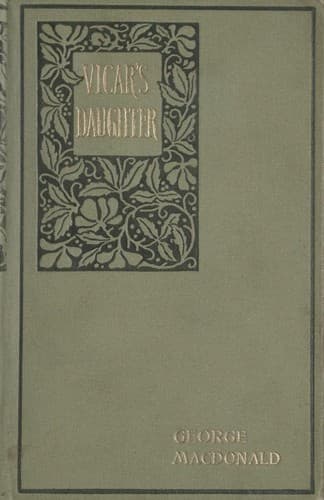
Children of clergy -- Fiction; Christian fiction; Fathers and daughters -- Fiction; Scotland -- Fiction
"It seems likely enough," he added. Then after another pause--"I have your
address. The child shall be brought back to you the moment she's found. We
can't mistake her after your description."
"Where are you going now?" I said to my husband, as we left the station to
re-enter the cab.
"I don't know," he answered, "except we go home and question all the shops
in the neighborhood."
"Let us go to Miss Clare first," I said.
"By all means," he answered.
We were soon at the entrance of Lime Court.
When we turned the corner in the middle of it, we heard the sound of a
piano.
"She's at home!" I cried, with a feeble throb of satisfaction. The fear
that she might be out had for the last few moments been uppermost.
We entered the house, and ascended the stairs in haste. Not a creature
did we meet, except a wicked-looking cat. The top of her head was black,
her forehead and face white; and the black and white were shaped so as to
look like hair parted over a white forehead, which gave her green eyes a
frightfully human look as she crouched in the corner of a window-sill in
the light of a gas-lamp outside. But before we reached the top of the first
stair we heard the sounds of dancing, as well as of music. In a moment
after, with our load of gnawing fear and helpless eagerness, we stood in
the midst of a merry assembly of men, women, and children, who filled Miss
Clare's room to overflowing. It was Saturday night, and they were gathered
according to custom for their weekly music.
They made a way for us; and Miss Clare left the piano, and came to meet us
with a smile on her beautiful face. But, when she saw our faces, hers fell.
"What _is_ the matter, Mrs. Percivale?" she asked in alarm.
I sunk on the chair from which she had risen.
"We've lost Ethel," said my husband quietly.
"What do you mean? You don't"--
"No, no: she's gone; she's stolen. We don't know where she is," he answered
with faltering voice. "We've just been to the police."
Miss Clare turned white; but, instead of making any remark, she called
out to some of her friends whose good manners were making them leave the
room,--
"Don't go, please; we want you." Then turning to me, she asked, "May I do
as I think best?"
"Yes, certainly," answered my husband.
"My friend, Mrs. Percivale," she said, addressing the whole assembly, "has
lost her little girl."
A murmur of dismay and sympathy arose.
"What can we do to find her?" she went on.
They fell to talking among themselves. The next instant, two men came up
to us, making their way from the neighborhood of the door. The one was a
keen-faced, elderly man, with iron-gray whiskers and clean-shaved chin; the
other was my first acquaintance in the neighborhood, the young bricklayer.
The elder addressed my husband, while the other listened without speaking.
"Tell us what she's like, sir, and how she was dressed--though that ain't
much use. She'll be all different by this time."
Public-domain text, read in full here on John Shaqi.
Reviews
Reviews
No reviews yet
Be the first to share your thoughts on this work.
Elsewhere in the archive
Join the Discussion
Join the discussion
Sign in to leave a comment or review.
Sign InorCreate an account