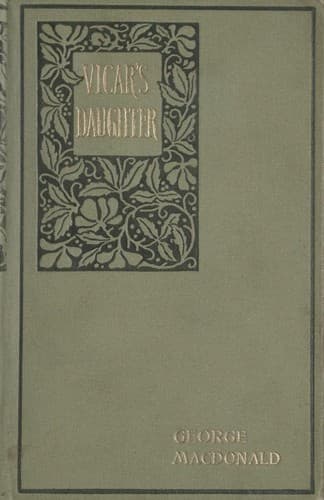
Children of clergy -- Fiction; Christian fiction; Fathers and daughters -- Fiction; Scotland -- Fiction
showing the deepest interest in such lowly forms as few would notice except
from a scientific knowledge, of which she had none: it was the thing
itself--its look and its home--that drew her attention. I cannot help
thinking that this insight was profoundly one with her interest in the
corresponding regions of human life and circumstance.
CHAPTER XXVII.
MISS CLARE AMONGST HER FRIENDS.
I must give an instance of the way in which Marion--I am tired of calling
her _Miss Clare_, and about this time I began to drop it--exercised her
influence over her friends. I trust the episode, in a story so fragmentary
as mine, made up of pieces only of a quiet and ordinary life, will not seem
unsuitable. How I wish I could give it you as she told it to me! so graphic
was her narrative, and so true to the forms of speech amongst the London
poor. I must do what I can, well assured it must come far short of the
original representation.
One evening, as she was walking up to her attic, she heard a noise in
one of the rooms, followed by a sound of weeping. It was occupied by a
journeyman house-painter and his wife, who had been married several years,
but whose only child had died about six months before, since which loss
things had not been going on so well between them. Some natures cannot bear
sorrow: it makes them irritable, and, instead of drawing them closer to
their own, tends to isolate them. When she entered, she found the woman
crying, and the man in a lurid sulk.
"What _is_ the matter?" she asked, no doubt in her usual cheerful tone.
"I little thought it would come to this when I married him," sobbed the
woman, while the man remained motionless and speechless on his chair, with
his legs stretched out at full length before him.
"Would you mind telling me about it? There may be some mistake, you know."
"There ain't no mistake in _that_," said the woman, removing the apron she
had been holding to her eyes, and turning a cheek towards Marion, upon
which the marks of an open-handed blow were visible enough. "I didn't marry
him to be knocked about like that."
"She calls that knocking about, do she?" growled the husband. "What did she
go for to throw her cotton gownd in my teeth for, as if it was my blame she
warn't in silks and satins?"
After a good deal of questioning on her part, and confused and
recriminative statement on theirs, Marion made out the following as the
facts of the case:--
Public-domain text, read in full here on John Shaqi.
Reviews
Reviews
No reviews yet
Be the first to share your thoughts on this work.
Elsewhere in the archive
Join the Discussion
Join the discussion
Sign in to leave a comment or review.
Sign InorCreate an account