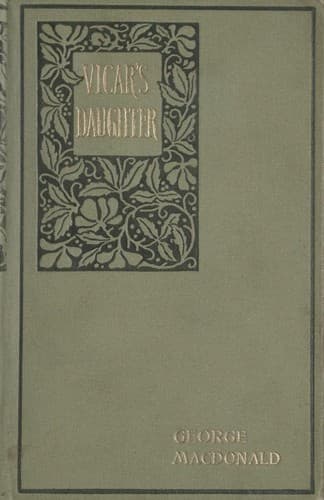
Children of clergy -- Fiction; Christian fiction; Fathers and daughters -- Fiction; Scotland -- Fiction
I am not sorry that I have no _special_ faculty for saving; for I have
never known any, in whom such was well developed, who would not do things
they ought to be ashamed of. The savings of such people seem to me to come
quite as much off other people as off themselves; and, especially in regard
of small sums, they are in danger of being first mean, and then dishonest.
Certainly, whoever makes saving _the_ end of her life, must soon grow mean,
and will probably grow dishonest. But I have never succeeded in drawing the
line betwixt meanness and dishonesty: what is mean, so far as I can see,
slides by indistinguishable gradations into what is plainly dishonest. And
what is more, the savings are commonly made at the cost of the defenceless.
It is better far to live in constant difficulties than to keep out of them
by such vile means as must, besides, poison the whole nature, and make
one's judgments, both of God and her neighbors, mean as her own conduct.
It is nothing to say that you must be just before you are generous, for
that is the very point I am insisting on; namely, that one must be just to
others before she is generous to herself. It will never do to make your
two ends meet by pulling the other ends from the hands of those who are
likewise puzzled to make them meet.
But I must now put myself at the bar, and cry _Peccavi_; for I was often
wrong on the other side, sometimes getting things for the house before it
was quite clear I could afford them, and sometimes buying the best when an
inferior thing would have been more suitable, if not to my ideas, yet to my
purse. It is, however, far more difficult for one with an uncertain income
to learn to save, or even to be prudent, than for one who knows how much
exactly every quarter will bring.
My husband, while he left the whole management of money matters to me,
would yet spend occasionally without consulting me. In fact, he had no
notion of money, and what it would or would not do. I never knew a man
spend less upon himself; but he would be extravagant for me, and I dared
hardly utter a foolish liking lest he should straightway turn it into a
cause of shame by attempting to gratify it. He had, besides, a weakness for
over-paying people, of which neither Marion nor I could honestly approve,
however much we might admire the disposition whence it proceeded.
Now that I have confessed, I shall be more easy in my mind; for, in regard
of the troubles that followed, I cannot be sure that I was free of blame.
One word more in self-excuse, and I have done: however imperative, it is
none the less hard to cultivate two opposing virtues at one and the same
time.
Public-domain text, read in full here on John Shaqi.
Reviews
Reviews
No reviews yet
Be the first to share your thoughts on this work.
Elsewhere in the archive
Join the Discussion
Join the discussion
Sign in to leave a comment or review.
Sign InorCreate an account