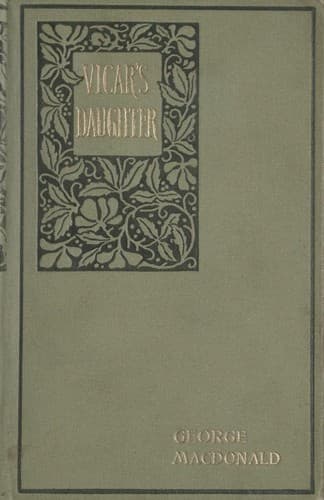
Children of clergy -- Fiction; Christian fiction; Fathers and daughters -- Fiction; Scotland -- Fiction
I said the same to myself, and tried the question in many ways. The fact
remained, that we could not commune, that is, with any heartiness; and,
although I may have done her wrong, it was, I thought, to be accounted
for something in this way. The Saviour of whom she spoke so often, and
evidently thought so much, was in a great measure a being of her own fancy;
so much so, that she manifested no desire to find out what the Christ was
who had spent three and thirty years in making a revelation of himself to
the world. The knowledge she had about him was not even at second-hand,
but at many removes. She did not study his words or his actions to learn
his thoughts or his meanings; but lived in a kind of dreamland of her own,
which could be interesting only to the dreamer. Now, if we are to come to
God through Christ, it must surely be by knowing Christ; it must be through
the knowledge of Christ that the Spirit of the Father mainly works in the
members of his body; and it seemed to me she did not take the trouble to
"know him and the power of his resurrection." Therefore we had scarcely
enough of common ground, as I say, to meet upon. I could not help
contrasting her religion with that of Marion Clare.
At length I had a note from her, begging me to go and see her at her house
at Richmond, and apologizing for her not coming to me, on the score of
her health. I felt it my duty to go, but sadly grudged the loss of time
it seemed, for I expected neither pleasure nor profit from the visit.
Percivale went with me, and left me at the door to have a row on the river,
and call for me at a certain hour.
The house and grounds were luxurious and lovely both, two often dissociated
qualities. She could have nothing to desire of this world's gifts, I
thought. But the moment she entered the room into which I had been shown, I
was shocked at the change I saw in her. Almost to my horror, she was in a
widow's cap; and disease and coming death were plain on every feature. Such
was the contrast, that the face in my memory appeared that of health.
"My dear Mrs. Cromwell!" I gasped out.
"You see," she said, and sitting down, on a straight-backed chair, looked
at me with lustreless eyes.
Death had been hovering about her windows before, but had entered at last;
not to take the sickly young woman longing to die, but the hale man, who
would have clung to the last edge of life.
"He is taken, and I am left," she said abruptly, after a long pause.
Her drawl had vanished: pain and grief had made her simple. "Then," I
thought with myself, "she did love him!" But I could say nothing. She took
my silence for the sympathy it was, and smiled a heart-rending smile, so
different from that little sad smile she used to have; really pathetic
now, and with hardly a glimmer in it of the old self-pity. I rose, put my
arms about her, and kissed her on the forehead; she laid her head on my
shoulder, and wept.
Public-domain text, read in full here on John Shaqi.
Reviews
Reviews
No reviews yet
Be the first to share your thoughts on this work.
Elsewhere in the archive
Join the Discussion
Join the discussion
Sign in to leave a comment or review.
Sign InorCreate an account