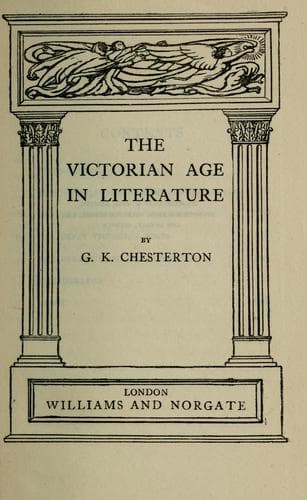
The Victorian Age in LiteratureChesterton, G. K. (Gilbert Keith)
History
The Victorian Age in Literature
Chesterton, G. K. (Gilbert Keith)
English literature -- 19th century -- History and criticism
But what Meredith did do for women was not to emancipate them (which
means nothing) but to express them, which means a great deal. And he
often expressed them right, even when he expressed himself wrong. Take,
for instance, that phrase so often quoted: "Woman will be the last thing
civilised by man." Intellectually it is something worse than false; it
is the opposite of what he was always attempting to say. So far from
admitting any equality in the sexes, it logically admits that a man may
use against a woman any chains or whips he has been in the habit of
using against a tiger or a bear. He stood as the special champion of
female dignity: but I cannot remember any author, Eastern or Western,
who has so calmly assumed that man is the master and woman merely the
material, as Meredith really does in this phrase. Any one who knows a
free woman (she is generally a married woman) will immediately be
inclined to ask two simple and catastrophic questions, first: "Why
should woman be civilised?" and, second: "Why, if she is to be
civilised, should she be civilised by man?" In the mere intellectualism
of the matter, Meredith seems to be talking the most brutal sex
mastery: he, at any rate, has not doubled Cape Turk, nor even passed
Seraglio Point. Now why is it that we all really feel that this
Meredithian passage is not so insolently masculine as in mere logic it
would seem? I think it is for this simple reason: that there is
something about Meredith making us feel that it is not woman he
disbelieves in, but civilisation. It is a dark undemonstrated feeling
that Meredith would really be rather sorry if woman were civilised by
man--or by anything else. When we have got that, we have got the real
Pagan--the man that does believe in Pan.
It is proper to put this philosophic matter first, before the æsthetic
appreciation of Meredith, because with Meredith a sort of passing bell
has rung and the Victorian orthodoxy is certainly no longer safe.
Dickens and Carlyle, as we have said, rebelled against the orthodox
compromise: but Meredith has escaped from it. Cosmopolitanism,
Socialism, Feminism are already in the air; and Queen Victoria has
begun to look like Mrs. Grundy. But to escape from a city is one thing:
to choose a road is another. The free-thinker who found himself outside
the Victorian city, found himself also in the fork of two very different
naturalistic paths. One of them went upwards through a tangled but
living forest to lonely but healthy hills: the other went down to a
swamp. Hardy went down to botanise in the swamp, while Meredith climbed
towards the sun. Meredith became, at his best, a sort of daintily
dressed Walt Whitman: Hardy became a sort of village atheist brooding
and blaspheming over the village idiot. It is largely because the
free-thinkers, as a school, have hardly made up their minds whether they
want to be more optimist or more pessimist than Christianity that their
small but sincere movement has failed.
Public-domain text, read in full here on John Shaqi.
Reviews
Reviews
No reviews yet
Be the first to share your thoughts on this work.
Elsewhere in the archive
Join the Discussion
Join the discussion
Sign in to leave a comment or review.
Sign InorCreate an account