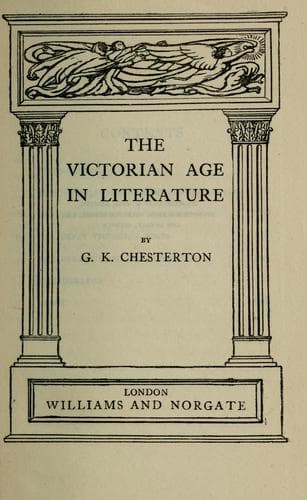
The Victorian Age in LiteratureChesterton, G. K. (Gilbert Keith)
History
The Victorian Age in Literature
Chesterton, G. K. (Gilbert Keith)
English literature -- 19th century -- History and criticism
For the duel is deadly; and any agnostic who wishes to be anything more
than a Nihilist must sympathise with one version of nature or the
other. The God of Meredith is impersonal; but he is often more healthy
and kindly than any of the persons. That of Thomas Hardy is almost made
personal by the intense feeling that he is poisonous. Nature is always
coming in to save Meredith's women; Nature is always coming in to betray
and ruin Hardy's. It has been said that if God had not existed it would
have been necessary to invent Him. But it is not often, as in Mr.
Hardy's case, that it is necessary to invent Him in order to prove how
unnecessary (and undesirable) He is. But Mr. Hardy is anthropomorphic
out of sheer atheism. He personifies the universe in order to give it a
piece of his mind. But the fight is unequal for the old philosophical
reason: that the universe had already given Mr. Hardy a piece of _its_
mind to fight with. One curious result of this divergence in the two
types of sceptic is this: that when these two brilliant novelists break
down or blow up or otherwise lose for a moment their artistic
self-command, they are both equally wild, but wild in opposite
directions. Meredith shows an extravagance in comedy which, if it were
not so complicated, every one would call broad farce. But Mr. Hardy has
the honour of inventing a new sort of game, which may be called the
extravagance of depression. The placing of the weak lover and his new
love in such a place that they actually see the black flag announcing
that Tess has been hanged is utterly inexcusable in art and probability;
it is a cruel practical joke. But it is a practical joke at which even
its author cannot brighten up enough to laugh.
But it is when we consider the great artistic power of these two
writers, with all their eccentricities, that we see even more clearly
that free-thought was, as it were, a fight between finger-posts. For it
is the remarkable fact that it was the man who had the healthy and manly
outlook who had the crabbed and perverse style; it was the man who had
the crabbed and perverse outlook who had the healthy and manly style.
The reader may well have complained of paradox when I observed above
that Meredith, unlike most neo-Pagans, did in his way take Nature
naturally. It may be suggested, in tones of some remonstrance, that
things like "though pierced by the cruel acerb," or "thy fleetingness is
bigger in the ghost," or "her gabbling grey she eyes askant," or "sheer
film of the surface awag" are not taking Nature naturally. And this is
true of Meredith's style, but it is not true of his spirit; nor even,
apparently, of his serious opinions. In one of the poems I have quoted
he actually says of those who live nearest to that Nature he was always
praising--
"Have they but held her laws and nature dear,
They mouth no sentence of inverted wit";
Public-domain text, read in full here on John Shaqi.
Reviews
Reviews
No reviews yet
Be the first to share your thoughts on this work.
Elsewhere in the archive
Join the Discussion
Join the discussion
Sign in to leave a comment or review.
Sign InorCreate an account