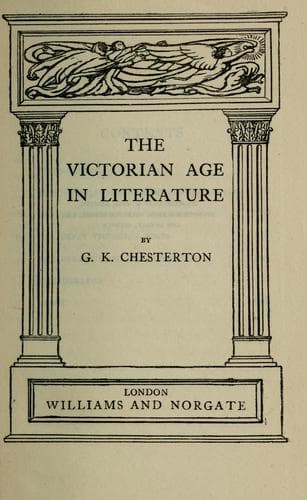
The Victorian Age in LiteratureChesterton, G. K. (Gilbert Keith)
History
The Victorian Age in Literature
Chesterton, G. K. (Gilbert Keith)
English literature -- 19th century -- History and criticism
The poem should have been a cry above the conquered years. It might well
have been that if the poet could have said sharply at the end of it, as
a pure piece of dogma, "I've forgotten every feature of the man's face:
I know God holds him alive." But under the influence of the mere
leisurely length of the thing, the reader _does_ rather receive the
impression that the wound has been healed only by time; and that the
victor hours _can_ boast that this is the man that loved and lost, but
all he was is overworn. This is not the truth; and Tennyson did not
intend it for the truth. It is simply the result of the lack of
something militant, dogmatic and structural in him: whereby he could not
be trusted with the trail of a very long literary process without
entangling himself like a kitten playing cat's-cradle.
Browning, as above suggested, got on much better with eccentric and
secluded England because he treated it as eccentric and secluded; a
place where one could do what one liked. To a considerable extent he did
do what he liked; arousing not a few complaints; and many doubts and
conjectures as to why on earth he liked it. Many comparatively
sympathetic persons pondered upon what pleasure it could give any man to
write _Sordello_ or rhyme "end-knot" to "offend not." Nevertheless he
was no anarchist and no mystagogue; and even where he was defective, his
defect has commonly been stated wrongly. The two chief charges against
him were a contempt for form unworthy of an artist, and a poor pride in
obscurity. The obscurity is true, though not, I think, the pride in it;
but the truth about this charge rather rises out of the truth about the
other. The other charge is not true. Browning cared very much for form;
he cared very much for style. You may not happen to like his style; but
he did. To say that he had not enough mastery over form to express
himself perfectly like Tennyson or Swinburne is like criticising the
griffin of a mediæval gargoyle without even knowing that it is a
griffin; treating it as an infantile and unsuccessful attempt at a
classical angel. A poet indifferent to form ought to mean a poet who did
not care what form he used as long as he expressed his thoughts. He
might be a rather entertaining sort of poet; telling a smoking-room
story in blank verse or writing a hunting-song in the Spenserian stanza;
giving a realistic analysis of infanticide in a series of triolets; or
proving the truth of Immortality in a long string of limericks. Browning
certainly had no such indifference. Almost every poem of Browning,
especially the shortest and most successful ones, was moulded or graven
in some special style, generally grotesque, but invariably deliberate.
In most cases whenever he wrote a new song he wrote a new kind of song.
The new lyric is not only of a different metre, but of a different
shape. No one, not even Browning, ever wrote a poem in the same style as
that horrible one beginning "John, Master of the Temple of God," with
Public-domain text, read in full here on John Shaqi.
Reviews
Reviews
No reviews yet
Be the first to share your thoughts on this work.
Elsewhere in the archive
Join the Discussion
Join the discussion
Sign in to leave a comment or review.
Sign InorCreate an account