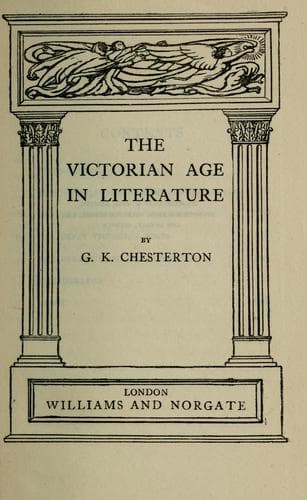
The Victorian Age in LiteratureChesterton, G. K. (Gilbert Keith)
History
The Victorian Age in Literature
Chesterton, G. K. (Gilbert Keith)
English literature -- 19th century -- History and criticism
He was a troubadour even in theology and
metaphysics: like the _Jongleurs de Dieu_ of St. Francis. He may be said
to have serenaded heaven with a guitar, and even, so to speak, tried to
climb there with a rope ladder. Thus his most vivid things are the
red-hot little love lyrics, or rather, little love dramas. He did one
really original and admirable thing: he managed the real details of
modern love affairs in verse, and love is the most realistic thing in
the world. He substituted the street with the green blind for the faded
garden of Watteau, and the "blue spirt of a lighted match" for the
monotony of the evening star.
Before leaving him it should be added that he was fitted to deepen the
Victorian mind, but not to broaden it. With all his Italian sympathies
and Italian residence, he was not the man to get Victorian England out
of its provincial rut: on many things Kingsley himself was not so
narrow. His celebrated wife was wider and wiser than he in this sense;
for she was, however one-sidedly, involved in the emotions of central
European politics. She defended Louis Napoleon and Victor Emmanuel; and
intelligently, as one conscious of the case against them both. As to
why it now seems simple to defend the first Italian King, but absurd to
defend the last French Emperor--well, the reason is sad and simple. It
is concerned with certain curious things called success and failure, and
I ought to have considered it under the heading of _The Book of Snobs_.
But Elizabeth Barrett, at least, was no snob: her political poems have
rather an impatient air, as if they were written, and even published,
rather prematurely--just before the fall of her idol. These old
political poems of hers are too little read to-day; they are amongst the
most sincere documents on the history of the times, and many modern
blunders could be corrected by the reading of them. And Elizabeth
Barrett had a strength really rare among women poets; the strength of
the phrase. She excelled in her sex, in epigram, almost as much as
Voltaire in his. Pointed phrases like: "Martyrs by the pang without the
palm"--or "Incense to sweeten a crime and myrrh to embitter a curse,"
these expressions, which are witty after the old fashion of the conceit,
came quite freshly and spontaneously to her quite modern mind. But the
first fact is this, that these epigrams of hers were never so true as
when they turned on one of the two or three pivots on which contemporary
Europe was really turning. She is by far the most European of all the
English poets of that age; all of them, even her own much greater
husband, look local beside her. Tennyson and the rest are nowhere. Take
any positive political fact, such as the final fall of Napoleon.
Tennyson wrote these profoundly foolish lines--
"He thought to quell the stubborn hearts of oak
Madman!"
Public-domain text, read in full here on John Shaqi.
Reviews
Reviews
No reviews yet
Be the first to share your thoughts on this work.
Elsewhere in the archive
Join the Discussion
Join the discussion
Sign in to leave a comment or review.
Sign InorCreate an account