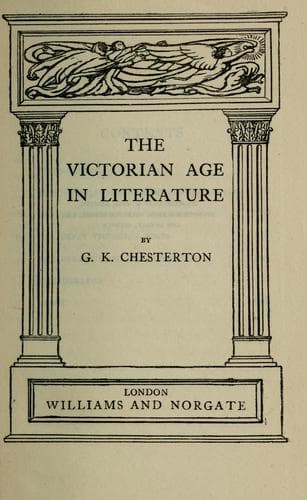
The Victorian Age in LiteratureChesterton, G. K. (Gilbert Keith)
History
The Victorian Age in Literature
Chesterton, G. K. (Gilbert Keith)
English literature -- 19th century -- History and criticism
One poet, or, to speak more strictly, one poem, belongs to the same
general atmosphere and impulse as Swinburne; the free but languid
atmosphere of later Victorian art. But this time the wind blew from
hotter and heavier gardens than the gardens of Italy. Edward
Fitzgerald, a cultured eccentric, a friend of Tennyson, produced what
professed to be a translation of the Persian poet Omar, who wrote
quatrains about wine and roses and things in general. Whether the
Persian original, in its own Persian way, was greater or less than this
version I must not discuss here, and could not discuss anywhere. But it
is quite clear that Fitzgerald's work is much too good to be a good
translation. It is as personal and creative a thing as ever was written;
and the best expression of a bad mood, a mood that may, for all I know,
be permanent in Persia, but was certainly at this time particularly
fashionable in England. In the technical sense of literature it is one
of the most remarkable achievements of that age; as poetical as
Swinburne and far more perfect. In this verbal sense its most arresting
quality is a combination of something haunting and harmonious that flows
by like a river or a song, with something else that is compact and
pregnant like a pithy saying picked out in rock by the chisel of some
pagan philosopher. It is at once a tune that escapes and an inscription
that remains. Thus, alone among the reckless and romantic verses that
first rose in Coleridge or Keats, it preserves something also of the wit
and civilisation of the eighteenth century. Lines like "a Muezzin from
the tower of darkness cries," or "Their mouths are stopped with dust"
are successful in the same sense as "Pinnacled dim in the intense inane"
or "Through verdurous glooms and winding mossy ways." But--
"Indeed, indeed, repentance oft before
I swore; but was I sober when I swore?"
is equally successful in the same sense as--
"Damn with faint praise, assent with civil leer
And without sneering teach the rest to sneer."
Public-domain text, read in full here on John Shaqi.
Reviews
Reviews
No reviews yet
Be the first to share your thoughts on this work.
Elsewhere in the archive
Join the Discussion
Join the discussion
Sign in to leave a comment or review.
Sign InorCreate an account