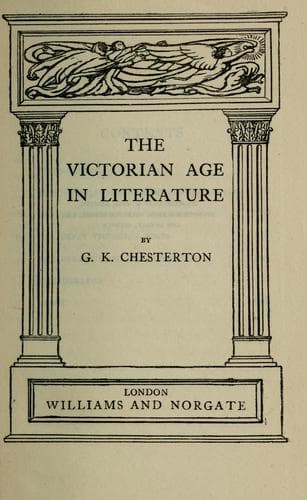
The Victorian Age in LiteratureChesterton, G. K. (Gilbert Keith)
History
The Victorian Age in Literature
Chesterton, G. K. (Gilbert Keith)
English literature -- 19th century -- History and criticism
as they are with democracy or with any other intelligent proposition
ever offered. But these unintelligent propositions were offered; and the
ultimate result was this rather important one: that the harshness of
Utilitarianism began to turn into downright tyranny. That beautiful
faith in human nature and in freedom which had made delicate the dry air
of John Stuart Mill; that robust, romantic sense of justice which had
redeemed even the injustices of Macaulay--all that seemed slowly and
sadly to be drying up. Under the shock of Darwinism all that was good in
the Victorian rationalism shook and dissolved like dust. All that was
bad in it abode and clung like clay. The magnificent emancipation
evaporated; the mean calculation remained. One could still calculate in
clear statistical tables, how many men lived, how many men died. One
must not ask how they lived; for that is politics. One must not ask how
they died; for that is religion. And religion and politics were ruled
out of all the Later Victorian debating clubs; even including the
debating club at Westminster. What third thing they were discussing,
which was neither religion nor politics, I do not know. I have tried the
experiment of reading solidly through a vast number of their records and
reviews and discussions; and still I do not know. The only third thing I
can think of to balance religion and politics is art; and no one well
acquainted with the debates at St. Stephen's will imagine that the art
of extreme eloquence was the cause of the confusion. None will maintain
that our political masters are removed from us by an infinite artistic
superiority in the choice of words. The politicians know nothing of
politics, which is their own affair: they know nothing of religion,
which is certainly not their affair: it may legitimately be said that
they have to do with nothing; they have reached that low and last level
where a man knows as little about his own claim, as he does about his
enemies'. In any case there can be no doubt about the effect of this
particular situation on the problem of ethics and science. The duty of
dragging truth out by the tail or the hind leg or any other corner one
can possibly get hold of, a perfectly sound duty in itself, had somehow
come into collision with the older and larger duty of knowing something
about the organism and ends of a creature; or, in the everyday phrase,
being able to make head or tail of it. This paradox pursued and
tormented the Victorians. They could not or would not see that humanity
repels or welcomes the railway-train, simply according to what people
come by it. They could not see that one welcomes or smashes the
telephone, according to what words one hears in it. They really seem to
have felt that the train could be a substitute for its own passengers;
or the telephone a substitute for its own voice.
Public-domain text, read in full here on John Shaqi.
Reviews
Reviews
No reviews yet
Be the first to share your thoughts on this work.
Elsewhere in the archive
Join the Discussion
Join the discussion
Sign in to leave a comment or review.
Sign InorCreate an account