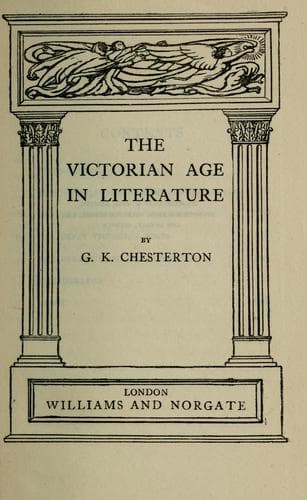
The Victorian Age in LiteratureChesterton, G. K. (Gilbert Keith)
History
The Victorian Age in Literature
Chesterton, G. K. (Gilbert Keith)
English literature -- 19th century -- History and criticism
It was a great calamity that the freedom of Wilkes and the faith of Dr.
Johnson fought each other. But it was an even worse calamity that they
practically killed each other. They killed each other almost
simultaneously, like Herminius and Mamilius. Liberalism (in Newman's
sense) really did strike Christianity through headpiece and through
head; that is, it did daze and stun the ignorant and ill-prepared
intellect of the English Christian. And Christianity did smite
Liberalism through breastplate and through breast; that is, it did
succeed, through arms and all sorts of awful accidents, in piercing more
or less to the heart of the Utilitarian--and finding that he had none.
Victorian Protestantism had not head enough for the business; Victorian
Radicalism had not heart enough for the business. Down fell they dead
together, exactly as Macaulay's Lay says, and still stood all who saw
them fall almost until the hour at which I write.
This coincident collapse of both religious and political idealism
produced a curious cold air of emptiness and real subconscious
agnosticism such as is extremely unusual in the history of mankind. It
is what Mr. Wells, with his usual verbal delicacy and accuracy, spoke of
as that ironical silence that follows a great controversy. It is what
people less intelligent than Mr. Wells meant by calling themselves _fin
de siècle_; though, of course, rationally speaking, there is no more
reason for being sad towards the end of a hundred years than towards the
end of five hundred fortnights. There was no arithmetical autumn, but
there was a spiritual one. And it came from the fact suggested in the
paragraphs above; the sense that man's two great inspirations had
failed him together. The Christian religion was much more dead in the
eighteenth century than it was in the nineteenth century. But the
republican enthusiasm was also much more alive. If their scepticism was
cold, and their faith even colder, their practical politics were wildly
idealistic; and if they doubted the kingdom of heaven, they were
gloriously credulous about the chances of it coming on earth. In the
same way the old pagan republican feeling was much more dead in the
feudal darkness of the eleventh or twelfth centuries, than it was even a
century later; but if creative politics were at their lowest, creative
theology was almost at its highest point of energy.
Public-domain text, read in full here on John Shaqi.
Reviews
Reviews
No reviews yet
Be the first to share your thoughts on this work.
Elsewhere in the archive
Join the Discussion
Join the discussion
Sign in to leave a comment or review.
Sign InorCreate an account