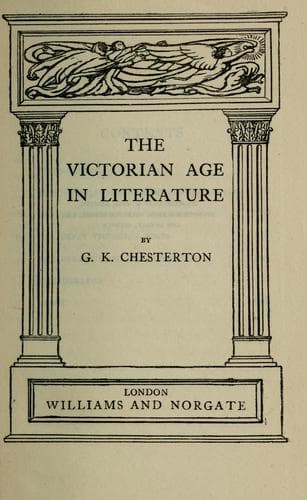
The Victorian Age in LiteratureChesterton, G. K. (Gilbert Keith)
History
The Victorian Age in Literature
Chesterton, G. K. (Gilbert Keith)
English literature -- 19th century -- History and criticism
admire the figures that walk about in his afternoon drawing-rooms; but
we have a certain sense that they are figures that have no faces.
For the rest, he is most widely known, or perhaps only most widely
chaffed, because of a literary style that lends itself to parody and is
a glorious feast for Mr. Max Beerbohm. It may be called The Hampered, or
Obstacle Race Style, in which one continually trips over commas and
relative clauses; and where the sense has to be perpetually qualified
lest it should mean too much. But such satire, however friendly, is in
some sense unfair to him; because it leaves out his sense of general
artistic design, which is not only high, but bold. This appears, I
think, most strongly in his short stories; in his long novels the reader
(or at least one reader) does get rather tired of everybody treating
everybody else in a manner which in real life would be an impossible
intellectual strain. But in his short studies there is the unanswerable
thing called real originality; especially in the very shape and point of
the tale. It may sound odd to compare him to Mr. Rudyard Kipling: but he
is like Kipling and also like Wells in this practical sense: that no one
ever wrote a story at all like the _Mark of the Beast_; no one ever
wrote a story at all like _A Kink in Space_: and in the same sense no
one ever wrote a story like _The Great Good Place_. It is alone in order
and species; and it is masterly. He struck his deepest note in that
terrible story, _The Turn of the Screw_; and though there is in the
heart of that horror a truth of repentance and religion, it is again
notable of the Victorian writers that the only supernatural note they
can strike assuredly is the tragic and almost the diabolic. Only Mr. Max
Beerbohm has been able to imagine Mr. Henry James writing about
Christmas.
Now upon this interregnum, this cold and brilliant waiting-room which
was Henry James at its highest and Wilde at its worst, there broke in
two positive movements, largely honest though essentially unhistoric and
profane, which were destined to crack up the old Victorian solidity past
repair. The first was Bernard Shaw and the Socialists: the second was
Rudyard Kipling and the Imperialists. I take the Socialists first not
because they necessarily came so in order of time, but because they were
less the note upon which the epoch actually ended.
Public-domain text, read in full here on John Shaqi.
Reviews
Reviews
No reviews yet
Be the first to share your thoughts on this work.
Elsewhere in the archive
Join the Discussion
Join the discussion
Sign in to leave a comment or review.
Sign InorCreate an account