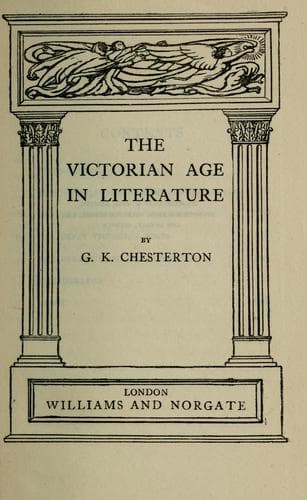
The Victorian Age in LiteratureChesterton, G. K. (Gilbert Keith)
History
The Victorian Age in Literature
Chesterton, G. K. (Gilbert Keith)
English literature -- 19th century -- History and criticism
I shall not talk here, any more than anywhere else in this book, about
the "sedulous ape" business. No man ever wrote as well as Stevenson who
cared only about writing. Yet there is a sense, though a misleading one,
in which his original inspirations were artistic rather than purely
philosophical. To put the point in that curt covenanting way which he
himself could sometimes command, he thought it immoral to neglect
romance. The whole of his real position was expressed in that phrase of
one of his letters "our civilisation is a dingy ungentlemanly business:
it drops so much out of a man." On the whole he concluded that what had
been dropped out of the man was the boy. He pursued pirates as Defoe
would have fled from them; and summed up his simplest emotions in that
touching _cri de cœur_ "shall we never shed blood?" He did for the
penny dreadful what Coleridge had done for the penny ballad. He proved
that, because it was really human, it could really rise as near to
heaven as human nature could take it. If Thackeray is our youth,
Stevenson is our boyhood: and though this is not the most artistic
thing in him, it is the most important thing in the history of Victorian
art. All the other fine things he did were, for curious reasons, remote
from the current of his age. For instance, he had the good as well as
the bad of coming from a Scotch Calvinist's house. No man in that age
had so healthy an instinct for the actuality of positive evil. In _The
Master of Ballantrae_ he did prove with a pen of steel, that the Devil
is a gentleman--but is none the less the Devil. It is also
characteristic of him (and of the revolt from Victorian respectability
in general) that his most blood-and-thunder sensational tale is also
that which contains his most intimate and bitter truth. _Dr. Jekyll and
Mr. Hyde_ is a double triumph; it has the outside excitement that
belongs to Conan Doyle with the inside excitement that belongs to Henry
James. Alas, it is equally characteristic of the Victorian time that
while nearly every Englishman has enjoyed the anecdote, hardly one
Englishman has seen the joke--I mean the point. You will find twenty
allusions to Jekyll and Hyde in a day's newspaper reading. You will also
find that all such allusions suppose the two personalities to be equal,
neither caring for the other. Or more roughly, they think the book means
that man can be cloven into two creatures, good and evil. The whole stab
of the story is that man _can't_: because while evil does not care for
good, good must care for evil. Or, in other words, man cannot escape
from God, because good is the God in man; and insists on omniscience.
This point, which is good psychology and also good theology and also
good art, has missed its main intention merely because it was also good
story-telling.
Public-domain text, read in full here on John Shaqi.
Reviews
Reviews
No reviews yet
Be the first to share your thoughts on this work.
Elsewhere in the archive
Join the Discussion
Join the discussion
Sign in to leave a comment or review.
Sign InorCreate an account