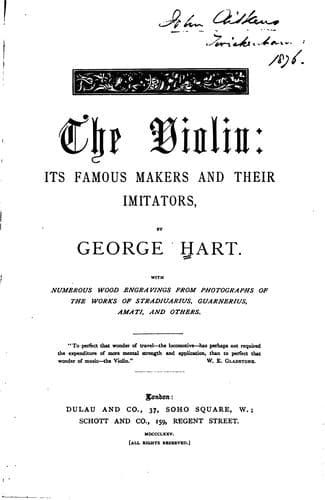
The Violin: Its Famous Makers and Their ImitatorsHart, George
History
The Violin: Its Famous Makers and Their Imitators
Hart, George
Violin -- History; Violin makers -- Biography
Panormo furnishes us with another example of the certain appreciation,
sooner or later, of exceptional talents. No matter how trifling the
circumstances under which gifted men have laboured, some time or other
their genius is discovered, and acknowledged with its due award, if
not of fortune, at least of fame. The peculiar circumstances under
which Panormo lived would have been sufficient in the case of most men
to dwarf all efforts. Unable to obtain readily that patronage to which
his abilities justly entitled him, he removed from city to city,
hoping to discover a resting-place, in which favour might attend his
art. No doubt this was a mistaken course, and one which robbed his
work of the attention which a mind undisturbed by the care of
existence can bestow; nevertheless his natural gifts had a vitality
that could not entirely be suppressed. He worked and toiled for his
art and for bare sustenance alternately. His life, like that of many
others in the paths of literature and science, was a continued battle
with adversity. Such persons are forced to satisfy daily wants by
slaving at work which brings them but little credit in after time, and
becomes a standard by which they are too often erroneously judged.
Vincenzo Panormo was the slave of many, manufacturing Double Basses
and other instruments from the material selected and purchased by his
temporary employer, ofttimes compelled to carry out some crotchet of
the patron much against his own wishes. The wood thus forced upon him
was often of the worst description; and, in addition, he was
frequently obliged to complete his work within a given time.
Instruments manufactured under such conditions can scarcely, it may be
supposed, add to their maker's reputation. We cannot but regret that
he should have been obliged to waste himself on such poor materials.
Fortunately, however, in some cases he found time to exercise his
skilful powers to their full extent, and has thus bequeathed to us
some of the finest specimens of the copyist's art.
His workmanship is of a lighter description than that of Lupot, and is
therefore more graceful. The sound-hole is admirably cut, and the
scroll also well carved.
PANSANI, Antonio, Rome, 1735.
PASTA, Antonio, Brescia, 1700-1730. Good work. Model a little high;
varnish of soft quality.
PASTA, Domenico, Brescia, about 1700.
PAZZINI, Gaetano, Florence, about 1630, pupil of Maggini.
PICINO, Padua, 1712. High model; dark varnish.
PLATNER, Michel, Rome, about 1750. The instruments of this maker
resemble those of Tecchler, both in workmanship and varnish.
Michael Platner fecit Romae anno 17--
POLLUSCA, Antonio, Rome, about 1751.
POSTIGLIONE, Vincenzo, Naples, contemporary.
PRESSENDA, Giovanni Francesco, Turin.
Joannes Franciscus Pressenda
q. Raphael fecit Taurini
Anno Domini 1826.
Public-domain text, read in full here on John Shaqi.
Reviews
Reviews
No reviews yet
Be the first to share your thoughts on this work.
Elsewhere in the archive
Join the Discussion
Join the discussion
Sign in to leave a comment or review.
Sign InorCreate an account