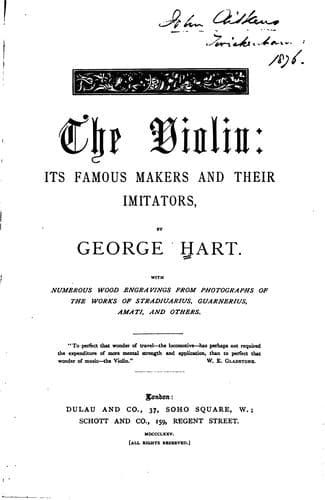
The Violin: Its Famous Makers and Their ImitatorsHart, George
History
The Violin: Its Famous Makers and Their Imitators
Hart, George
Violin -- History; Violin makers -- Biography
RUGGERI, Giambattista, Cremona. About 1693. Also called himself Il
Per. Lancetti suggests that this maker was a relative of Francesco. He
made several Violoncellos of large size and deep sides, the wood of
which is often plain. The varnish is of good quality and dark brown
colour. He also made Violins and Tenors, the latter being excellent
instruments.
SACCHINI, Sebastiano.
Sebastino Sacchni da Pesaro l'anno 1686.
SALO, Gasparo da.
Gasparo da Salo Brescia.
His real name was Gasparo dei Bertolotti. The researches of Cavalliere
Livi, keeper of the Brescian Archives, have brought to light much
valuable information as to this famous maker. He was born in the town
of Salo (Province of Brescia) in or about the year 1542, died there on
the 14th of April, 1609, and was buried in the church of San Joseffo.
A son (Francesco) appears to have worked with him and to have died in
1614. Several Viols of Gasparo's workmanship, of different sizes, are
still extant. The Violins are very rare. A few large Violas exist, the
tone of which is magnificent. His genuine labels bear no date. Gio
Paolo Maggini was apprenticed to him, and is believed to have
purchased the business, after Gasparo's death, from his son Francesco.
To Gasparo da Salo belongs the credit of having laid the foundation of
the Italian style of Violin-making. In his works may be traced the
gradual development of the system upon which his followers built their
reputation, viz., a well-defined model, excellent materials, and
choice varnish. It is to be regretted that his immediate followers,
with the exception of Paolo Maggini, departed from the path so
successfully trodden by this great pioneer. But for this deviation,
the works of the early Amati and a few others would have occupied a
higher position than that which they now command. They were men
possessing great abilities, and might easily have carried out the
designs of the great Brescian maker. They appear, however, to have
arrived at a different conclusion, as regards the form of their
instrument, from that shaped by Gasparo da Salo. Their works show an
evident preference for the high model, and thus undid much that
Gasparo had accomplished. It is clear that Gasparo only arrived at his
conclusions after painstaking labour, for he commenced with the high
form, and gradually, as experience taught, lowered it. It is, further,
remarkable that the latter members of the Amati family pursued the
same course as Andrea Amati (though in a less degree), after which
they awoke, as it were, to the reasonableness of the example set by
Gasparo, and gave us those instruments so highly thought of by the
connoisseur, the form of which has much in common with that adopted by
Niccolo Amati and perfected by Antonio Stradivari.
Public-domain text, read in full here on John Shaqi.
Reviews
Reviews
No reviews yet
Be the first to share your thoughts on this work.
Elsewhere in the archive
Join the Discussion
Join the discussion
Sign in to leave a comment or review.
Sign InorCreate an account