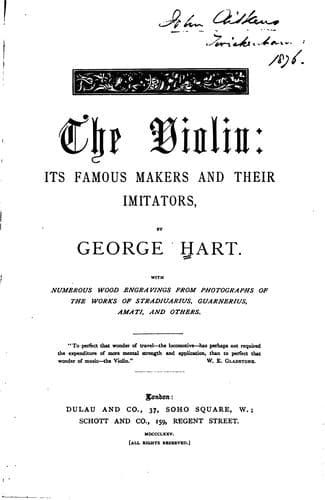
The Violin: Its Famous Makers and Their ImitatorsHart, George
History
The Violin: Its Famous Makers and Their Imitators
Hart, George
Violin -- History; Violin makers -- Biography
numbered with the rarities of Luigi Tarisio's collection, and highly
valued by him as a specimen of the maker. Among his Violins, the
instrument formerly owned by Lord Amherst, of Hackney, is unique; the
infancy of the Violin at this period is better seen here than any
specimen with which I am acquainted. The Violin of this make which
belonged to Ole Bull, and with which I am familiar, is another
well-known example. This instrument is characteristic of its author.
Its varnish is soft-looking and rich, though paler than usual. The
finger-board is inlaid, and is made of a light description of wood.
The head is carved and painted, and is a very choice piece of Italian
work.
SANONI, Giovanni Battista, Verona. About 1740. His instruments are
seldom met with in England. High model.
SANTO, Giovanni, Naples, 1700-30. Copied Amati. Varnish very hard, and
workmanship indifferent.
SANZO, Milan. Middle and early eighteenth century. Similar to
Grancino.
SARDI, ----, Venice, 1649. A broken Violin bearing this name was at
the Milan Exhibition, 1881.
SEIGHER, Girolamo. Worked in the shop of Niccolo Amati from 1680 to
1682.
SELLAS, Matteo, Lute-maker. M. Chouquet, in his "Catalogue Raisonne"
of the instruments at the Paris Conservatoire, mentions two Arch-Lutes
made by this maker.
SERAFINO, Santo, Udine--Venice, 1710-48.
Sanctus Seraphin
utinensis Fecit
Venetijs Ann. 17--
This maker is chiefly famed for the exquisite finish of his
workmanship. The modelling of his instruments varied. There are
instances, particularly in the case of his Violins, where he has
entirely set aside the Stainer form, and copied Amati. These Violins
are wonderfully like the work of Francesco Ruggeri. The varnish upon
them, of a rich red colour, is of so exceptional a quality, that one
is compelled to look twice before being satisfied as to the author.
The greater number, however, of his instruments are of the German
character, the sound-hole, scroll, and outline all hinting of Stainer.
These Venetians were wonderfully fortunate in obtaining handsome wood,
and in this respect Santo Serafino was pre-eminent, for his sides and
backs are simply beautiful to perfection. His method of cutting the
wood was invariably to show the grain in even stripes. The scroll is
well cut in point of workmanship, but the style is poor. Santo
Serafino cannot be regarded as having displayed originality in any
shape, and he thus forms an exception to the great majority of Italian
makers. His instruments are either copies of Amati or of Stainer;
there is, of course, a strong Italian flavour about his Stainer
copies, which lifts them above the German school of imitators, and
hence their higher value. Nearly all his instruments were branded with
his name above the tail-pin. He used an ornamental label of large
size. The Violoncello in the possession of Mr. M. J. Astle is a
charming specimen of Serafino's work, I may say unequalled.
Public-domain text, read in full here on John Shaqi.
Reviews
Reviews
No reviews yet
Be the first to share your thoughts on this work.
Elsewhere in the archive
Join the Discussion
Join the discussion
Sign in to leave a comment or review.
Sign InorCreate an account