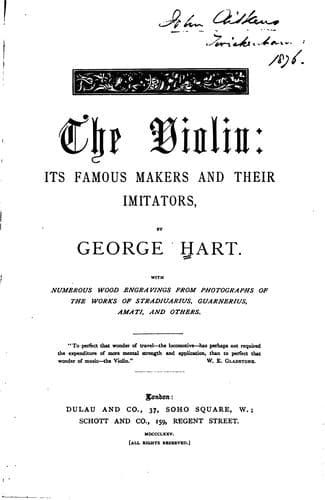
The Violin: Its Famous Makers and Their ImitatorsHart, George
History
The Violin: Its Famous Makers and Their Imitators
Hart, George
Violin -- History; Violin makers -- Biography
Having met with a Violin by Stradivari (since the publication of the
first edition of this work) dated 1666, it would appear that he left
the workshop of his master at that time, or not later than the year of
his marriage in 1667. The extracts obtained by Canon Bazzi from the
parish registers, relative to the pupils of Niccolo Amati, help to
establish the correctness of this view. Stradivari must have been in
the workshop of his master between the years 1658 and 1666. We have no
information of the pupils of Amati from 1654 to 1665. In 1666 the name
of Giorgio Fraiser is given; consequently Stradivari must have left
previous to 1666 or early in that year, and prior to the registration.
Between the years 1666 and 1672 there is observable a marked change in
style, and the workmanship is better. The instruments he made about
this period have wood for the most part singularly plain, and
different in kind from what his master used. His use of this material
I am disposed to attribute to the want of means rather than choice.
The purfling of these early instruments is very narrow, and many of
the backs are cut slab-form. Previous to about the year 1672, we find
that his whole work is in accordance with the plans of Amati (not as
seen in the latter's _grand_ pattern, but in his ordinary full-sized
instrument); the arching is identical, the corners are treated
similarly, the sound-hole is quite Amati-like in form, yet easily
distinguished by its extreme delicacy, the scroll a thorough imitation
of Amati, and presenting a singular contrast to the vigorous
individuality which Stradivari displayed in this portion of his work a
few years later. Enough has been said to enable the reader to
recognise the connection which must have existed between Amati and
Stradivari, to admit of such marked resemblances. Taking the
instruments of Stradivari as beacons throwing light upon many curious
and interesting points of the maker's manufacture, the number and
character of his Violins and Violoncellos made during the decade
following 1674 is indicative of his having increased both his
reputation and his patronage. The last year of this period, namely
1684, was that in which his master, Niccolo Amati, died, at the age of
eighty-eight. We have already seen, in the notice of Amati, that
Niccolo was the last member of the family who maintained unbroken the
long chain of associations connected with the house of Amati,
extending over a period of a century and a half. The circumstance of
all the tools, patterns, and models of Niccolo Amati having passed
into the possession of his pupil Stradivari, and not into that of his
son Girolamo (who was then thirty-five years of age), clearly shows
that the son did not succeed to his father's business. We are thus led
to believe that during the ten years above referred to, Niccolo Amati
had been gradually lessening his activity, and that the patronage so
long enjoyed by the Amati family fell for the most part to his gifted
Public-domain text, read in full here on John Shaqi.
Reviews
Reviews
No reviews yet
Be the first to share your thoughts on this work.
Elsewhere in the archive
Join the Discussion
Join the discussion
Sign in to leave a comment or review.
Sign InorCreate an account