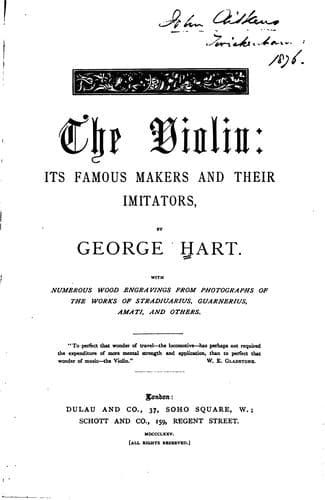
The Violin: Its Famous Makers and Their ImitatorsHart, George
History
The Violin: Its Famous Makers and Their Imitators
Hart, George
Violin -- History; Violin makers -- Biography
their work is totally inadequate.
The case of modern Violin-makers is unfortunate. Old Violins being
immeasurably superior to modern productions, the demand must
necessarily set steadily for the former, and the modern maker has only
the few patrons of new work to support him. It cannot be expected that
the players of to-day should patronise the modern Violin in order that
the next generation should reap the benefit. Years since it was quite
a different matter. The makers were well paid for their work, and new
instruments were then made to supply wants similar to those which the
horrid Mirecourt or Saxon copy fulfils at present. As with other
things, so is it also with Violins; if they are to be produced with
the stamp of artistic merit, they must be paid for accordingly;
without patronage the worker necessarily becomes careless. Finding
that his skill fails to attract attention, he gradually sinks down
into the mere routine of the ordinary workman. When Italy shone
brightest in art, the patronage and remuneration which the workers
received was considerable. Had it been otherwise, the powers of its
Raffaele, its Cellini, and last (though not least to the admirers of
the Violin), its Stradivari, would have remained simply dormant. Art,
like commerce, is regulated in a great measure by supply and demand.
In Raffaele's day, sacred subjects were in demand; the Church was his
great patron, and aided him in bringing forth the gift which nature
had implanted within him. In modern times, landscape-painting became
the favoured subject, particularly in England; the result of which
preference has been to place us in the foremost rank in that branch of
art. The stage furnishes another instance of the effect that patronage
has in bringing forth latent talent. If the history of dramatic art be
traced, it will be found that its chief works were written when the
taste of an appreciative public could be securely counted upon. As it
waned, so the writers of merit became rarer; or perhaps it would be
more correct to say, the plays produced became less meritorious, the
authors being constrained to pander to the prevailing tastes.
As further evidence of the effect of patronage on art, a case in point
is found in the manufacture of Venetian glass. The Venetians,
centuries ago, became famous for their works in glass, and the
patronage they enjoyed was world-wide; but their country being thrown
into an unsettled condition, capital drifted from it, until the
blowing of glass, together with other industries, was comparatively
extinguished. Within recent years the art of making glass has shown
signs, even in Venice itself, of reviving with all its former vigour
in the workshops of Salviati, the success of which is due in great
measure to English capital.
Public-domain text, read in full here on John Shaqi.
Reviews
Reviews
No reviews yet
Be the first to share your thoughts on this work.
Elsewhere in the archive
Join the Discussion
Join the discussion
Sign in to leave a comment or review.
Sign InorCreate an account