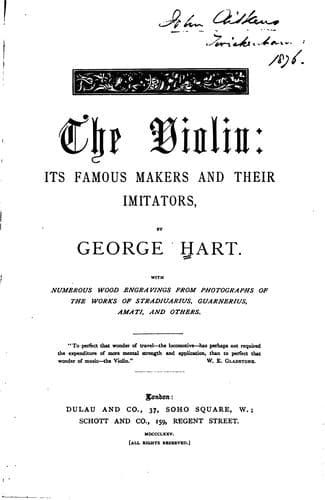
The Violin: Its Famous Makers and Their ImitatorsHart, George
History
The Violin: Its Famous Makers and Their Imitators
Hart, George
Violin -- History; Violin makers -- Biography
Benjamin Banks,
Musical Instrument Maker
In Catherine Street, Salisbury.
1780.
To this famous maker must be given the foremost place in the English
School. He was a thorough artist, and would not have been thought
lightly of had he worked in Cremona's school, and been judged by its
standard. This may be considered excessive praise of our native maker;
but an unprejudiced judge of work need only turn to the best specimens
of Banks's instruments, and he will confess that I have merely
recorded a _fact_.
Banks is, again, one of the many instances of men who have gained a
lasting reputation, but whose histories have never reached the light
to which their names have attained. How interesting would it be to
obtain the name of his master in the knowledge of making instruments!
No clue whatever remains by which we could arrive at a satisfactory
conclusion on this point. That he was an enthusiast in his art is
certain, and also that he was aware to some extent that he possessed
talent of no mean description. This is evidenced by the fact that many
of his instruments are branded with the letters B. B. in several
places, as though he felt that sooner or later his works would be
highly esteemed, and would survive base imitations, and that by
carefully branding them he might prevent any doubt as to their author.
Many of his best instruments are found to have no brand: it would
seem, therefore, that he did not so mark them for some time. He
appears to have early shown a preference for the model of Niccolo
Amati, and laboured unceasingly in imitation of him, until he copied
him with an exactness difficult to surpass. Now that time has mellowed
his best works, they might pass as original Amatis with those not
perfectly versed in the characteristics of the latter. Many German
makers excelled as copyists of Amati; but these makers chiefly failed
in their varnish, whereas Banks was most happy in this particular,
both as regards colour and quality. If his varnish be closely
examined, its purity and richness of colour are readily seen. It has
all the characteristics of fine Italian varnish, being beautifully
transparent, mellow, and rich in its varieties of tints. It must be
distinctly understood that these remarks apply only to the very finest
works of this maker, there being many specimens which bear the label
of Banks in the framing of which he probably took but a small share,
leaving the chief part to be done by his son and others. Banks cannot
be considered as having been successful in the use of his varnish on
the bellies of his instruments, as he has allowed it to clog the
fibre, a blemish which affects the appearance very much, and has been
the means of casting discredit on the varnish among those unacquainted
with the real cause. The modelling is executed with skill.
Fortunately, sufficient wood has been left in his instruments to
enable time to exert its beneficial effects, a desideratum overlooked
by many makers of good repute.
Public-domain text, read in full here on John Shaqi.
Reviews
Reviews
No reviews yet
Be the first to share your thoughts on this work.
Elsewhere in the archive
Join the Discussion
Join the discussion
Sign in to leave a comment or review.
Sign InorCreate an account