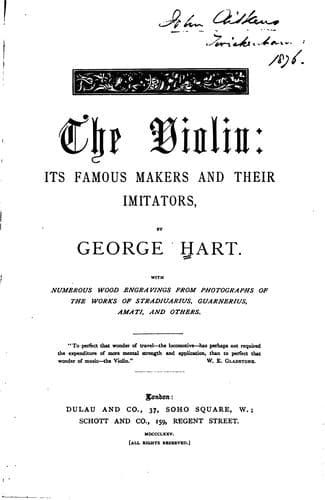
The Violin: Its Famous Makers and Their ImitatorsHart, George
History
The Violin: Its Famous Makers and Their Imitators
Hart, George
Violin -- History; Violin makers -- Biography
HILL, William Ebsworth, London, 1817-95. Son of Lockey Hill. Made
several instruments in his younger days, but, like the rest of our
English makers, he long since discovered that new work was
unremunerative, and turned his attention to repairing and dealing in
old instruments, and became the founder of the well-known firm of W.
E. Hill and Sons, of Bond Street. He exhibited at the Exhibition of
1862 a Violin and Tenor, thus showing that Violin-making was not quite
extinguished in England.
HOLLOWAY, J., London, 1794.
HUME, Richard, Edinburgh, 16th century. A maker of Lutes, &c.
JAY, Henry, London, 17th century. Maker of Viols, which are capital
specimens of the work of the period. The varnish is excellent.
JAY, Thomas, London. Related to the above. Excellent work.
JAY, Henry, London, about 1744-77.
Made by Henry Jay,
in Long Acre, London. 1746.
A maker of Kits chiefly. At this period these juvenile Violins were in
much demand by dancing-masters. A few years ago a very choice
collection of these instruments was made by an Irish gentleman
residing at Paris, who obtained specimens from all parts of Europe.
Henry Jay also made Violoncellos, some of which have the names of
Longman and Broderip on the back.
JOHNSON, John, London, 1750.
Made and sold by John Johnson,
at the Harp and Crown, in Cheapside,
17 London. 53
The Violins bearing his label are dated from Cheapside. Johnson was a
music and musical instrument seller. In "The Professional Life of
Dibdin," written by himself, we have the following reference to this
City music-seller: "My brother introduced me to old Johnson, who at
that time kept a capital music-shop in Cheapside.[1] I soon, however,
grew tired of an attendance on him. He set me down to tune
Harpsichords, a mere mechanical employment, not at all to my taste."
"I saw plainly that I might have screwed up Harpsichords in old
Johnson's shop to all eternity, without advancing my fortune; and as
to the songs and sonatas that I brought him for sale, they had not
been performed at the theatres nor Vauxhall, nor any other place, and
Johnson would not print them." "The Thompsons, however, of St. Paul's
Churchyard, published six ballads for me, which sold at
three-halfpence a-piece, and for the copyright of which they
generously gave me three guineas." Though we may not feel disposed to
apply the term "generous" to a payment of half-a-guinea for a Dibdin
ballad, yet in all probability we are indebted to the Thompsons for
this particular recognition of merit. Happily true genius, when in
straits, generally finds relief. Were it otherwise, and had the
Thompsons been as deaf to Dibdin as John Johnson appears to have been,
"Tom Bowling," "Poor Jack," and many other compositions of sterling
merit, might never have been written.[2]
Public-domain text, read in full here on John Shaqi.
Reviews
Reviews
No reviews yet
Be the first to share your thoughts on this work.
Elsewhere in the archive
Join the Discussion
Join the discussion
Sign in to leave a comment or review.
Sign InorCreate an account