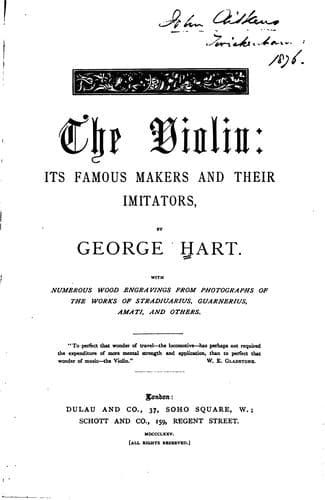
The Violin: Its Famous Makers and Their ImitatorsHart, George
History
The Violin: Its Famous Makers and Their Imitators
Hart, George
Violin -- History; Violin makers -- Biography
Charles Lamb, on being asked how he distinguished his "ragged
veterans" in their tattered and unlettered bindings, answered, "How
does a shepherd know his sheep?" It has been observed that, "Touch
becomes infinitely more exquisite in men whose employment requires
them to examine the polish of bodies than it is in others. In music
only the simplest and plainest compositions are relished at first; use
and practice extend our pleasure--teach us to relish finer melody, and
by degrees enable us to enter into the intricate and compounded
pleasure of harmony." Thus it is with connoisseurship in Violins.
Custom and observation, springing from a natural disposition, make
prominent features and minute points of difference before unseen,
resulting in a knowledge of style of which it has been well said
"Every man has his own, like his own nose."
As an ardent votary of the Violin, regarded from a point of view at
once artistic and curious, Count Cozio di Salabue takes precedence of
all others. He was born about the time when the art of Italian
Violin-making began to show signs of decadence, and having cultivated
a taste for Cremonese instruments, he resolved to gratify his passion
by bringing together a collection of Violins which should be
representative of the work and character of each maker, and serve as
models to those seeking to tread the path of the makers who made
Cremona eminent as a seat of Violin manufacture. Virtuosity emanating
from a spirit of beneficence is somewhat rare. When, however, utility
occupies a prominent place in the thoughts of the virtuoso, he becomes
a benefactor. The virtuosity of Count Cozio was of this character. His
love for Cremonese instruments was neither whimsical nor transient.
From the time when he secured the contents of the shop of Stradivari
to the end of his life--a period of about fifty years--he appears to
have exerted himself to obtain as much information as possible
relative to the art, and to collect masterpieces that they might in
some measure be the means of recovering a lost art. When in the year
1775 he secured ten instruments out of ninety-one which Stradivari
left in his shop at the time of his death, he must surely have
considered himself singularly fortunate, and the happiest of
collectors.[3] That such good fortune prompted him to make fresh
overtures of purchase cannot be wondered at. We learn from the
correspondence of Paolo Stradivari that the Count had caused two
letters to be sent by the firm of Anselmi di Briata to Paolo inquiring
if he was willing to part with the tools and patterns used by his
father Antonio, and that Paolo replied on May 4, 1776: "I have already
told you that I have no objection to sell all those patterns,
measures, and tools which I happen to have in my possession, provided
that they do not remain in Cremona, and you will recollect that I have
shown you all the tools I have, and also the box containing the
patterns.... I place all at your disposal, and as it is simply a
Public-domain text, read in full here on John Shaqi.
Reviews
Reviews
No reviews yet
Be the first to share your thoughts on this work.
Elsewhere in the archive
Join the Discussion
Join the discussion
Sign in to leave a comment or review.
Sign InorCreate an account