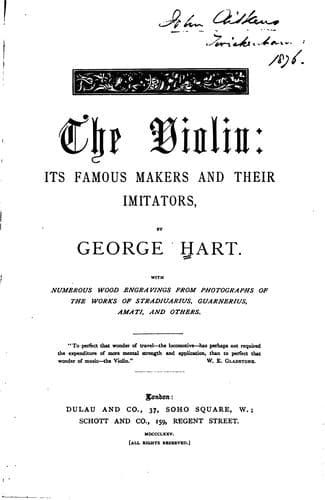
The Violin: Its Famous Makers and Their ImitatorsHart, George
History
The Violin: Its Famous Makers and Their Imitators
Hart, George
Violin -- History; Violin makers -- Biography
The late Joseph Gillott was a collector, who, in point of number,
exceeded all others. He did not confine himself solely to the works of
the greatest makers, but added specimens of every age and clime; and
at one time he must have had upwards of 500 instruments, the chief
part of which belonged to the Italian School. When it is remembered
that the vast multitude of stringed instruments disposed of by Messrs.
Christie and Manson in 1872 did not amount to one-half the number
originally owned by Mr. Gillott, some idea of the extent of his
collection may be gained. Among the many curious instances of the love
of collecting Violins, which sometimes possesses those unable to use
them, perhaps that of Mr. Gillott is the most singular.
Notable collections, be they of Fiddles, medals, pottery, or pictures,
have sometimes had their rise in accidents of a curious kind. Lord
Northwick dated his passion for coins to a bag of brass ones, which he
purchased in sport for eight pounds. His lordship ended by purchasing,
in conjunction with Payne Knight, the collection of Sir Robert
Ainslie, for eight thousand pounds, besides sharing with the same
collector the famous Sicilian coins belonging to the Prince
Torremuzza. The Gillott collection of Fiddles had its origin in a
picture deal. Mr. Gillott happened to be making terms in his gallery
at Edgbaston relative to an exchange of pictures with Edwin
Atherstone,[5] poet and novelist, who collected both Violins and
pictures. A difficulty arose in adjusting the balance, when Mr.
Atherstone suggested throwing a Fiddle in as a counterpoise. "That
would be to no purpose," remarked Mr. Gillott, "for I have neither
knowledge of music nor of the Fiddle." "I am aware of that," rejoined
his friend; "but Violins are often of extraordinary value as works of
art." Mr. Gillott, becoming interested in the subject, agreed to
accept the Fiddle as a make-weight, and the business was settled. A
few months later the floor of his picture gallery on all sides was
lined with cases, single and double, containing Violins in seemingly
endless profusion. It was about the year 1848 he conceived the notion
of bringing together this mammoth collection; and in about four years
he had made himself master of the largest number of Italian
instruments ever owned by a single individual. He suddenly
relinquished the pursuit he had followed with such persistency; he
disposed of a great number, and laid the remainder aside in his
steel-pen works at Birmingham, where they slumbered for upwards of
twenty years. The time at last arrived when this pile of Fiddles was
to be dispersed. It fell to my lot to classify them, and never shall I
forget the scene I witnessed. Here, amid the din of countless machines
busy shaping magnum-bonums, swan-bills, and divers other writing
implements, I was about to feast my eyes on some of the choicest works
of the old Italian Fiddle-makers. Passing through offices, warehouses,
Public-domain text, read in full here on John Shaqi.
Reviews
Reviews
No reviews yet
Be the first to share your thoughts on this work.
Elsewhere in the archive
Join the Discussion
Join the discussion
Sign in to leave a comment or review.
Sign InorCreate an account