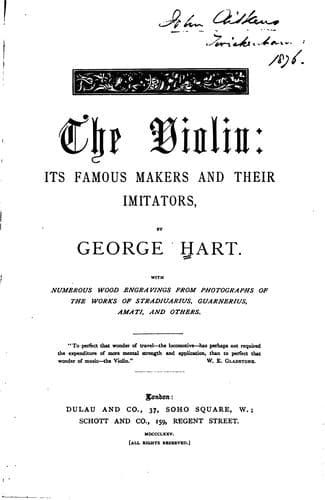
The Violin: Its Famous Makers and Their ImitatorsHart, George
History
The Violin: Its Famous Makers and Their Imitators
Hart, George
Violin -- History; Violin makers -- Biography
something of the kind on the premises, and started off to make
inquiry. Upon his return, I was conducted to an under warehouse, the
contents of which were of a varied character. Here were stored unused
lathes, statuary, antique pianos, parts of machinery, pictures, and
picture-frames. At the end of this long room stood, in stately form,
the "big Fiddles," about fifty in number--five rows, consequently ten
deep. They looked in their cases like a detachment of infantry
awaiting the word of command. Years had passed by since they had been
called upon to take active service of a pacific and humanising nature
in the ranks of the orchestra. Had they the power of speech, what
tales of heroism might they have furnished of the part they played at
the "Fall of Babylon" and the "Siege of Corinth," aye! and
"Wellington's Victory" (Beethoven, Op. 91). A more curious mixture of
art and mechanism could not easily be found than that which the
contents of this room exhibited. With what delight did I proceed to
open these long-closed cases! The character of the Violins naturally
led me to anticipate much artistic worth in the Violoncellos, and I
had not judged erroneously. Bergonzi, Amati, Andrea Guarneri, Cappa,
Grancino, Testore, Landolfi, and men of less note, were all well
represented in this army of big Fiddles. Having glanced at the merits
and demerits of these instruments, I observed to my conductor that I
imagined I had seen all. "No," he answered; "I was about to mention
that there are a few Violins at Mr. Gillott's residence, and perhaps
we had better go there at once." I readily assented, and in due time
reached Edgbaston. There seemed no doubt as to the whereabouts of
these instruments, and I was at once ushered into the late Mr.
Gillott's _bedroom_. Pointing to a long mahogany glazed case occupying
one side of the chamber, the attendant gave me to understand I should
there find the Violins. At once I commenced operations. Pushing aside
the first sliding door, I saw a row of those cardboard cases made to
hold the Violin only, which many of my readers will doubtless remember
seeing at the time of the sale at Messrs. Christie's. By this time it
may readily be imagined that an idea had taken possession of my mind,
that I had not, after all, seen the best portion of the collection.
The circumstance of Violins being deposited in the sleeping apartment
of their owner was sufficient to give birth to this conjecture. Upon
removing the lid of the first cardboard case, my eyes rested on a
charming Stradivari of the Amati period, a gem of its kind. Gently
laying it on the table, that I might examine it later, I opened the
next case. Here rested a magnificent Giuseppe Guarneri, the instrument
afterwards bought by Lord Dunmore, date 1732. Pursuing my delightful
occupation, I opened another case, the contents of which put the rest
completely in the shade--here rested the Stradivari, date 1715, the
gem of the collection. Unable to restrain my curiosity, I rapidly
Public-domain text, read in full here on John Shaqi.
Reviews
Reviews
No reviews yet
Be the first to share your thoughts on this work.
Elsewhere in the archive
Join the Discussion
Join the discussion
Sign in to leave a comment or review.
Sign InorCreate an account