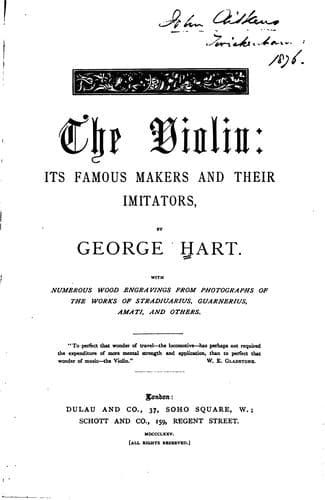
The Violin: Its Famous Makers and Their ImitatorsHart, George
History
The Violin: Its Famous Makers and Their Imitators
Hart, George
Violin -- History; Violin makers -- Biography
The earliest player on the Violin of whom we have any account worthy
of attention was Baltazarini, a native of Piedmont. He removed to
France in the year 1577, whither he was sent by Marshal de Brissac to
superintend the music of Catherine de Medici. He was probably the
introducer of Italian dances into Paris, and he delighted the Court as
much by his skill on the Violin as by his writing of ballet music.
During the last half of the sixteenth century a new species of music
made way in Italy which exercised a marked effect on the progress of
the Violin, namely, that of the concert orchestra. It was chiefly
cultivated at Venice and Ferrara. At the latter place the Duke of
Ferrara maintained a great number of musicians in his service. At this
period there were no concerts of a public character; they were given
in the palaces of the wealthy, and the performers were chiefly those
belonging to their private bands.
The opera, in which instruments were used to accompany the voice,
began to be put upon the stage of the public theatres in Italy about
the year 1600. The opera "Orfeo," by Claudio Monteverde, a Cremonese,
famous both as a composer and Violist, was represented in 1608. The
opera in those times differed essentially from that of modern days.
Particular instruments were selected to accompany each character; for
instance, ten Treble Viols to accompany Eurydice, two Bass Viols to
Orpheus, and so on. No mention is made of Violins further than that
two small Violins (duoi Violini piccoli alla Francese) are to
accompany the character of Hope, from which it is inferred that a band
of Violins was in use not much later.
It is to the introduction of the Sonata that the rapid progress in the
cultivation of Violin-playing is due. Dr. Burney tells us the earliest
Sonatas or Trios for two Violins and a Bass he discovered were
published by Francesco Turini, organist of the Duomo, at Brescia,
under the following title: "Madrigali a una, due, e tre voci, con
alcune Sonate a due e a tre, Venezia, 1624." He says: "I was
instigated by this early date to score one of these Sonatas, which
consisted of only a single movement in figure and imitation
throughout, in which so little use was made of the power of the bow in
varying the expression of the same notes, that each part might have
been as well played on one instrument as another."
Public-domain text, read in full here on John Shaqi.
Reviews
Reviews
No reviews yet
Be the first to share your thoughts on this work.
Elsewhere in the archive
Join the Discussion
Join the discussion
Sign in to leave a comment or review.
Sign InorCreate an account