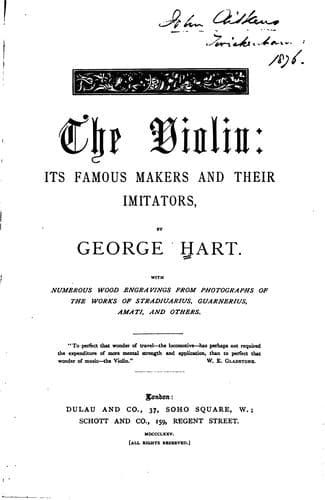
The Violin: Its Famous Makers and Their ImitatorsHart, George
History
The Violin: Its Famous Makers and Their Imitators
Hart, George
Violin -- History; Violin makers -- Biography
Henri Vieuxtemps was a thorough master of his art. His Concertos are
compositions worthy of the title they bear; they do not consist of a
number of difficulties strung together without meaning, but are
properly constructed works. He has written many Fantasias, all of
which are the delight of good Violinists. His compositions being most
difficult to render, they are chiefly known among artists, but in
these days of rapid development in Violin-playing among amateurs, a
new and wide field will certainly be opened for them.
From Belgium to Poland seems a wide step in my discourse, but it is
really not so. Although the Polish Violinists retain much originality
in their style of playing and compositions, it is to the French school
that they belong. Lipinski, Wieniawski, and Lotto were all educated in
the Paris school.
Lipinski has written a good deal for his instrument, and instructed
many well-known players.
Henri Wieniawski was essentially a great artist. He was a marvellous
Violinist, and displayed great genius as a composer for his
instrument.
Adolphe Pollitzer settled in London many years since, and occupied a
leading position among our resident Violinists.
Having lightly touched upon the various heads of the French school, I
must again take up the thread of the English history of the instrument
from about 1750, at which period we may trace a growing admiration for
Violin-playing, notwithstanding the disparagement which this
accomplishment received from different notabilities. Foremost among
the revilers stands Lord Chesterfield, who considered playing upon any
musical instrument to be illiberal in a gentleman. The Violin would
seem to have been regarded by his lordship with a supreme amount of
displeasure. His opinion of Violinists savoured greatly of that held
by the framers of the statute passed in the reign of Elizabeth
touching minstrels, who were to be included among "rogues, vagabonds,
and sturdy beggars" wandering abroad. Lord Chesterfield says, "Music
is usually reckoned one of the liberal arts, and not unjustly, but a
man of fashion who is seen piping or Fiddling at a concert degrades
his own dignity. If you love music, hear it; _pay Fiddlers to play for
you, but never Fiddle yourself_." Such was Lord Chesterfield's advice
to his son. It is quite evident that he had no notion of the exquisite
enjoyment derivable from being an executant in a quartette, the
conversational powers of which have been so frequently noticed. That
Lord Chesterfield's strictures discouraged the practice of the Violin
in the higher circles of society is very probable, appearing as they
do in a work which was held in the light of a textbook upon the
conduct of a gentleman for some considerable time. Happily, the
hollowness of much of his advice came to be recognised, and he who
deemed cards and dice a necessary step towards fashionable perfection,
and ordained that Fiddlers were to be paid to play for you as
Public-domain text, read in full here on John Shaqi.
Reviews
Reviews
No reviews yet
Be the first to share your thoughts on this work.
Elsewhere in the archive
Join the Discussion
Join the discussion
Sign in to leave a comment or review.
Sign InorCreate an account