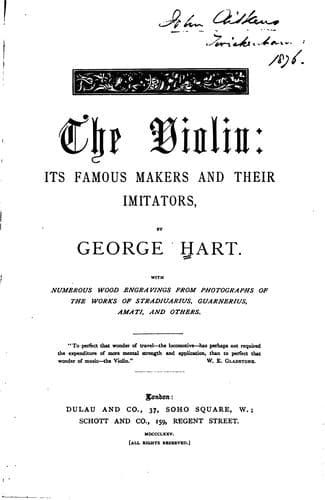
The Violin: Its Famous Makers and Their ImitatorsHart, George
History
The Violin: Its Famous Makers and Their Imitators
Hart, George
Violin -- History; Violin makers -- Biography
is evidently a most humorous allusion to the case of the Royalist, Sir
Roger L'Estrange, the friend of Butler, and to whom was given the
names of the real persons shadowed under fictitious characters in the
satire. Sir Roger, whilst in St. James's Park, heard an Organ being
played in the house of one Mr. Hickson. His intense love of music
prompted him to seek admittance. He found there a company of five or
six persons, and being himself a good Violist, was prevailed upon to
take a part. By-and-by Cromwell entered, without, Sir Roger explains
in a pamphlet ("Truth and Loyalty Vindicated," printed the year before
the first part of Hudibras was published, in 1662), "the least colour
of a design or expectation." Sir Roger went on making division with
his Viol, apparently regardless of the presence of the Protector and
thus earned for himself the title of Oliver's Fiddler, besides giving
rise to the report that he solicited a private conference with
Cromwell under the pretext of "making division" with his Viol. Dr.
Johnson has truly said of Hudibras, "The manners, being founded on
opinions, are temporary and local, and therefore become every day less
intelligible and less striking.... Much, therefore, of that humour
which transported the century with merriment is lost to us, who do not
know the sour solemnity, the sullen superstition, the gloomy
moroseness, and the stubborn scruples of the ancient Puritans, ... and
cannot, but by recollection and study, understand the lines in which
they are satirised. Our grandfathers knew the picture from the life;
we judge of the life by contemplating the picture."]
[Footnote 5: Alluding to an ordinance made in 1658: "And be it further
enacted by the authority aforesaid, that if any person or persons,
commonly called Fiddlers, or minstrels, shall at any time after the
said first day of July (1657) be taken playing, Fiddling, and making
music in any inn, alehouse, or tavern, or shall be taken proffering
themselves, or desiring, or intreating any person or persons to hear
them play, &c., &c., shall be adjudged ... rogues, vagabonds, and
sturdy beggars."]
[Footnote 6: Crowd, a Fiddle, and therefore for injury done by
"breach," or cracks, to Crowdero's instrument.]
[Footnote 7: The Fiddle-case referred to is one covered with leather,
studded with nails, and with a lid opening at the end, and might be
likened unto a mace.]
[Footnote 8: "This is an enigmatical description of a pair of stocks
and whipping-post. It is so pompous and sublime that we are surprised
so noble a structure could be raised from so ludicrous a subject. We
perceive wit and humour in the strongest light in every part of the
description."--_Note by Dr. Grey_.]
[Footnote 9: Dr. Nash suggests the following rendering: "His spoils,
the Fiddle, and the case."]
GEORGE HERBERT'S REFERENCES TO MUSIC.
Public-domain text, read in full here on John Shaqi.
Reviews
Reviews
No reviews yet
Be the first to share your thoughts on this work.
Elsewhere in the archive
Join the Discussion
Join the discussion
Sign in to leave a comment or review.
Sign InorCreate an account