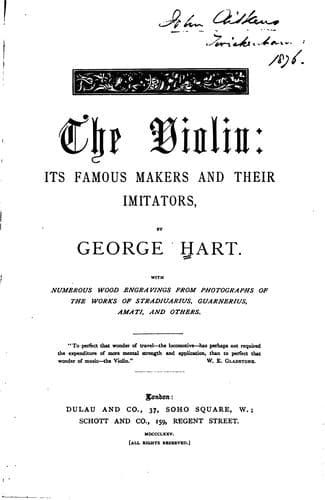
The Violin: Its Famous Makers and Their ImitatorsHart, George
History
The Violin: Its Famous Makers and Their Imitators
Hart, George
Violin -- History; Violin makers -- Biography
"... And now, my dear friend, let's draw our stools together, and have
some fun. Is it possible we can help talking of Haydn first? How do
you like him? What does he say? What does he do? What does he play
upon? How does he play?... The papers say he has been bowed to by
whole orchestras when he has appeared at the play-houses. Is he about
anything in the way of composition? Come, come! I'll pester you no
more with interrogations; but trust to your generosity to gratify my
ardent curiosity in your own way. I have just--and I am ashamed to say
but just--sent for his 'Stabat Mater.' Fisin[10] told me some
quartetts had, not long ago, been published by him. He has written so
much that I cannot help fearing he will soon have written himself dry.
If the resources of any human composer could be inexhaustible, I
should suppose Haydn's would; but as, after all, he is but mortal, I
am afraid he must soon get to the bottom of his genius-box. My friend
Mr. Tindal is come to settle (for the present at least) in this
neighbourhood. He is going to succeed me in the curacy of Fordham. He
plays the Fiddle well, the Harpsichord well, the Violoncello well.
Now, sir, when I say 'well,' I can't be supposed to mean the wellness
that one should predicate of a professor who makes the instrument his
study; but that he plays in a very ungentlemanlike manner, exactly in
time and tune, with taste, accent, and meaning, and the true sense of
what he plays; and, upon the Violoncello, he has execution sufficient
to play Boccherini's quintettos, at least what may be called very
decently. But ask Fisin, he will tell you about our Fiddling, and
vouch for our decency at least. I saw in one of the public prints an
insinuation that Haydn, upon his arrival in London, had detected some
forgeries, some things published in his name that were not done by
him. Is that true? It does not seem very unlikely."
[Footnote 10: James Fisin was born in Colchester; was intimate with
Dr. Burney, and well known as a Professor of Music.]
. . . . .
Haydn left Vienna December 15, 1790, and arrived with Salomon in
London on New Year's Day, 1791. The Rev. Thomas Twining's
interrogations addressed to Dr. Burney respecting him were therefore
made but a few weeks after Haydn's first arrival in England. Between
the months of January and May much had been seen and heard of Haydn,
information of which Dr. Burney gave to his friend, as seen in the
following letter:--
"COLCHESTER, _May_ 4, 1791.
"To DR. BURNEY,--
Public-domain text, read in full here on John Shaqi.
Reviews
Reviews
No reviews yet
Be the first to share your thoughts on this work.
Elsewhere in the archive
Join the Discussion
Join the discussion
Sign in to leave a comment or review.
Sign InorCreate an account