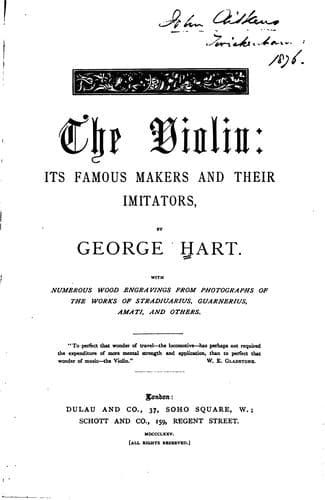
The Violin: Its Famous Makers and Their ImitatorsHart, George
History
The Violin: Its Famous Makers and Their Imitators
Hart, George
Violin -- History; Violin makers -- Biography
but on my mentioning the circumstance to my father, he informed me, to
my astonishment and delight, that if the head of the mongrel Fiddle
had been placed on the Stradivari, date 1710, from the Goding
collection, it was now, as the effect of recent transmigration, on its
own legitimate body.
A MONTAGNANA INSTRUMENT SHOT THROUGH THE BODY IN THE REVOLUTION OF
1848.
An enthusiastic amateur was playing the Violin in a house in one of
the leading thoroughfares in Paris at the outbreak of the Revolution
in 1848. His ardour was so great that the cannonading failed to
interrupt him in his pleasurable pursuit; he fiddled on, regardless of
all about him, as Nero is said to have done when his capital was in
flames, and even left the window of his apartment open. Presently a
whizzing noise, terminating in a thud above his head, arrested his
attention. Upon his looking up he saw the mark of a bullet in the
ceiling. Aroused to a sense of his danger, he closed the windows.
Being about to put his Montagnana into its case, his astonishment may
be imagined when he discovered a hole through the upper side, and a
corresponding chink in the belly, both as sharply cut as though a
centre-bit had done the work. His Violin bore witness to his
miraculous escape; the bullet lodged in the ceiling had taken his
Montagnana in its course. The instrument referred to in this anecdote
has been in my possession more than once.
FIDDLE MARKS AND THE CREDULOUS DABBLERS.
It is said that a drowning man will clutch at a straw; the truth of
the remark applies to the half-informed in Fiddle connoisseurship. It
is very amusing to note the pile of nothings that these persons heap
up under the name of "guiding points" in relation to Fiddles. I will
endeavour to call to mind a few of these. I will begin with those
little pegs seen on the backs of Violins near the button, and at the
bottom; the position of these airy nothings without habitation or name
"is deemed indisputable evidence of certain makers' handicraft." One
is supposed to have put his pegs to the right, another to the left;
another used three, four, and so on. I have frequently heard this
remark--"Oh, it cannot be a Stradivari, because the pegs are wrong!"
The purfling also forms an important item in the collection of
landmarks; certain makers are supposed to have invariably used one
kind of purfling, no variation being allowed for width or material
adopted. Original instruments are pronounced spurious and spurious
original by this test. All Fiddles purfled with whalebone are dubbed
"Jacobs," and no other maker is credited with using such purfling.
Public-domain text, read in full here on John Shaqi.
Reviews
Reviews
No reviews yet
Be the first to share your thoughts on this work.
Elsewhere in the archive
Join the Discussion
Join the discussion
Sign in to leave a comment or review.
Sign InorCreate an account