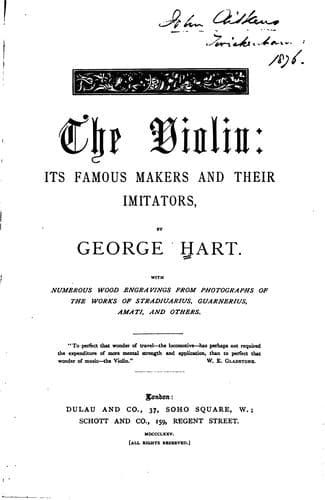
The Violin: Its Famous Makers and Their ImitatorsHart, George
History
The Violin: Its Famous Makers and Their Imitators
Hart, George
Violin -- History; Violin makers -- Biography
The first is in D, in
playing which you should accelerate the motion a little each time,
till you arrive at the quickest degree of swiftness possible; but two
precautions are necessary in this exercise--the first is, that you
play the notes _staccato_, that is, separate and detached, with a
little space between every two, for though they are written thus--
[Illustration]
they should be played as if there was a rest after every note, in this
manner--
[Illustration]
The second precaution is, that you first play with the point of the
bow; and when that becomes easy to you, that you use that part of it
which is between that part and the middle; and when you are likewise
mistress of this part of the bow, that you practise in the same manner
with the middle of the bow; and, above all, you must remember in these
studies to begin the _Allegros_ or flights sometimes with an up-bow;
and sometimes with a down-bow, carefully avoiding the habit of
constantly practising one way. In order to acquire a greater facility
of executing swift passages in a light and neat manner, it will be of
great use to you if you accustom yourself to skip over a string
between two quick notes in divisions, like these--
[Illustration]
Of such divisions you may play extempore as many as possible, and in
every key, which will be both useful and necessary.
"'With regard to the finger-board, or carriage of the left hand, I
have one thing strongly to recommend to you, which will suffice for
all; and that is, the taking a Violin part, either the first or second
of a concerto, sonata, or song--anything will serve the purpose--and
playing it upon the half-shift, that is, with the first finger upon G
on the first string, and constantly keeping upon this shift, playing
the whole piece without moving the hand from this situation, unless A
on the fourth string be wanted, or D upon the first; but in that case,
you should afterwards return again to the half-shift, without ever
moving the hand down to the natural position. This practice should be
continued till you can execute with facility upon the half-shift any
Violin part not intended as a solo, at sight. After this, advance the
hand on the finger-board to the whole-shift, with the first finger
upon A on the first string, and accustom yourself to this position
till you can execute everything upon the whole-shift with as much ease
as when the hand is in its natural situation; and when certain of
this, advance to the double-shift, with the first finger upon B, on
the first string; and when sure of that likewise, pass to the fourth
position of the hand, making C with the first finger upon the first
string; and indeed this is a scale in which, when you are firm, you
may be said to be mistress of the finger-board. This study is so
necessary, that I most earnestly recommend it to your attention.
Public-domain text, read in full here on John Shaqi.
Reviews
Reviews
No reviews yet
Be the first to share your thoughts on this work.
Elsewhere in the archive
Join the Discussion
Join the discussion
Sign in to leave a comment or review.
Sign InorCreate an account