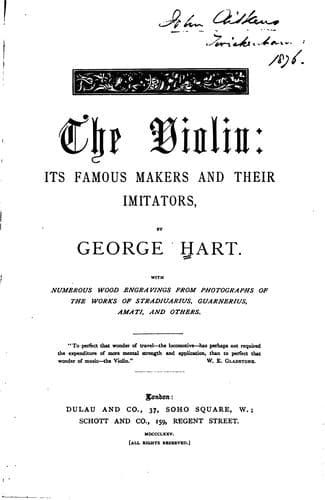
The Violin: Its Famous Makers and Their ImitatorsHart, George
History
The Violin: Its Famous Makers and Their Imitators
Hart, George
Violin -- History; Violin makers -- Biography
visible. The corners are drawn out to points of singular fineness, and
this gives them an appearance of prominence which serves to throw
beauty into the entire work. The model is raised somewhat towards the
centre, dipping rather suddenly from the feet of the bridge towards
the outer edge, and forming a slight groove where the purfling is
reached, but not the exaggerated scoop which is commonly seen in the
instruments of the many copyists. This portion of the design has
formed the subject of considerable discussion among the learned in the
Violin world, the debatable points being the appearance of this
peculiarity and its acoustic effect. As regards the former question,
the writer of these pages feels convinced that the apparent
irregularity is in perfect harmony with the general outline of the
great Amati's instrument; and it pleases the eye. From the acoustical
point of view, it may be conceded that it does not tend to increase of
power; but, on the other hand, probably, the sweetness of tone so
common to the instruments of Niccolo Amati must be set to its credit;
for, in proportion as the form is departed from, the sweetness is
found to decrease. The sound-hole has all the character of those of
the preceding Amati, together with increased boldness; in fact, it is
a repetition of that of Girolamo, with this exception. The sides are a
shade deeper than those of the brothers Amati. The scroll is
exquisitely cut. Its outline is perhaps a trifle contracted, and thus
is robbed of the vigour which it would otherwise possess. From this
circumstance it differs from the general tenor of the body, which is
certainly of broad conception. The maker would seem to have been aware
of this defect, if we may judge from the difference of form given to
his earlier scrolls, as compared with those of a later date, in which
he seems to have attempted to secure increased boldness, as more in
keeping with the character of the body of the instrument. It must be
acknowledged, however, that these efforts did not carry him far
enough. The surface of the scroll is usually inclined to flatness. The
wood used by Niccolo Amati for his grand instruments is of splendid
quality, both as regards acoustical requirements and beauty of
appearance. The grain of some of his backs has a wave-like form of
much beauty, others have markings of great regularity, giving to the
instrument a highly finished appearance. The bellies are of a soft
silken nature, and usually of even grain. A few of them are of
singular beauty, their grain being of a mottled character, which,
within its transparent coat of varnish, flashes light here and there
with singular force. The colour of the varnish varies in point of
depth; sometimes it is of a rich amber colour, at others
reddish-brown, and in a few instances light golden-red.
Public-domain text, read in full here on John Shaqi.
Reviews
Reviews
No reviews yet
Be the first to share your thoughts on this work.
Join the Discussion
Join the discussion
Sign in to leave a comment or review.
Sign InorCreate an account