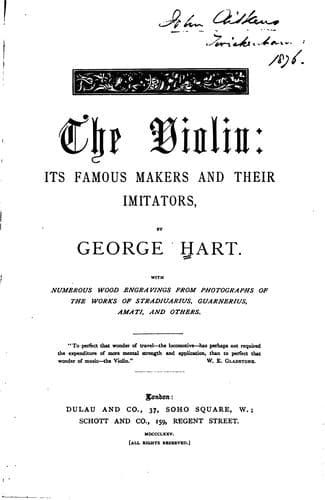
The Violin: Its Famous Makers and Their ImitatorsHart, George
History
The Violin: Its Famous Makers and Their Imitators
Hart, George
Violin -- History; Violin makers -- Biography
These, then, are the instruments which are so highly esteemed, and
which form one of the chief links in the Violin family. The highest
praise must be conceded to the originator of a design which combines
extreme elegance with utility; and, simple as the result may appear,
the successful construction of so graceful a whole must have been
attended with rare ingenuity and persevering labour.
Here, again, is evidence of the master mind, never resting, ever
seeking to improve--evidence, too, that mere elaboration of work was
not the sole aim of the Cremonese makers. They designed and created as
they worked, and their success, which no succeeding age has aspired to
rival, entitles them to rank with the chief artists of the world.
On the form of the instrument known as the "grand Amati" Stradivari
exerted all the power of his early years; and the fruits of his
labours are, in point of finish, unsurpassed by any of his later
works. Where Niccolo Amati failed, Stradivari conquered; and
particularly is this victory to be seen in the scrolls of his
instruments during the first period, which are masterpieces in
themselves. How bold is the conception, how delicate the workmanship,
what a marvel of perfection the sound-hole! But as these Violins are
noticed under the head of "Stradivari," it is unnecessary to enter
into details here. Beside Stradivari, many makers of less importance
followed the "grand Amati" pattern, among whom may be mentioned
Jacobs, of Amsterdam, who takes a prominent place as a copyist. The
truthfulness of these copies, as regards the chief portions of the
instrument, is singularly striking, so much so, indeed, as to cause
them to be frequently mistaken for originals by those who are not
deeply versed in the matter. The points of failure in these imitations
may be cited as the scroll and sound-hole. The former lacks ease, and
seems to defy its author to hide his nationality. The scroll has ever
proved the most troublesome portion of the Violin to the imitator. It
is here, if anywhere, that he must drop the mask and show his
individuality, and this is remarkably the case in the instance above
mentioned. A further difference between Amati and Jacobs lies in the
circumstance that the latter invariably used a purfling of whalebone.
Another copyist of Amati was Grancino. As the varnish which he used
was of a different nature from that of his original, his power of
imitation must be considered to be inferior to that of some others.
Numerous German makers, whose names will be found under the "German
School," were also liege subjects of Amati, and copied him with much
exactness; so also, last, but not least, our own countrymen, Forster,
Banks, and Samuel Gilkes.
Public-domain text, read in full here on John Shaqi.
Reviews
Reviews
No reviews yet
Be the first to share your thoughts on this work.
Join the Discussion
Join the discussion
Sign in to leave a comment or review.
Sign InorCreate an account