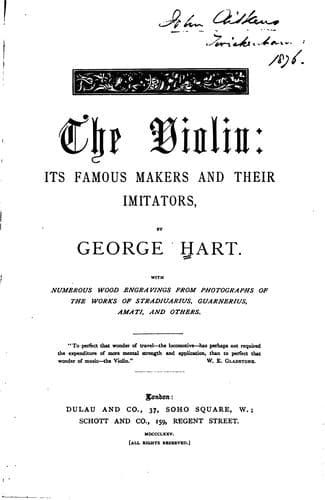
The Violin: Its Famous Makers and Their ImitatorsHart, George
History
The Violin: Its Famous Makers and Their Imitators
Hart, George
Violin -- History; Violin makers -- Biography
They possess tone of rare quality, are for the most part extremely
handsome, and, last and most important of all, their massive
construction has helped them, by fair usage and age, to become
instruments of the first order. The model of Bergonzi's Violins is
generally flat, and the outline of his early efforts is of the
Stradivari type; but later in life, he, in common with other great
Italian makers, marked out a pattern for himself from which to
construct. The essential difference between these two forms lies in
the angularity of the latter. It would be very difficult to describe
accurately the several points of deviation unless the reader could
handle the specimens for himself and have ocular demonstration; the
upper portion from the curve of the centre bouts is increased, and, in
consequence, the sound-holes are placed slightly lower than in the
Stradivari model. Bergonzi was peculiar in this arrangement, and he
seldom deviated from it. Again, increased breadth is given to the
lower portion of the instrument, and in consequence the centre bouts
are set at a greater angle than is customary. The sound-hole may be
described as an adaptation of the characteristics of both Stradivari
and Guarneri, inclining certainly more to those of the former. As a
further peculiarity, it is to be noticed that the sound-holes are set
nearer the edge than is the case in the instruments of either of the
makers named. Taken as a whole, Bergonzi's design is rich in artistic
feeling, and one which he succeeded in treating with the utmost skill.
Carlo Bergonzi furnishes us with another example of the extensive
research with which the great Cremonese makers pursued their art, and
a refutation of the common assertion that these men worked and formed
by accident rather than by judgment. The differences of the two makers
mentioned above, as regards form, are certainly too wide to be
explained away as a mere accident. It is further necessary to take
into consideration the kind of tone belonging to these instruments
respectively. If Bergonzi's instruments be compared with those of his
master, Stradivari, or of Guarneri del Gesu, the appreciable
difference to be found will amount to this, that in Bergonzi's
instruments there is a just and exact combination of the qualities of
both the other two makers named. Is it not, therefore, reasonable to
conclude that Carlo Bergonzi was fully alive to the merits of both
Stradivari and Guarneri, and deliberately set himself to construct a
model that should embrace in a measure the chief characteristics of
both of them?
Public-domain text, read in full here on John Shaqi.
Reviews
Reviews
No reviews yet
Be the first to share your thoughts on this work.
Elsewhere in the archive
Join the Discussion
Join the discussion
Sign in to leave a comment or review.
Sign InorCreate an account