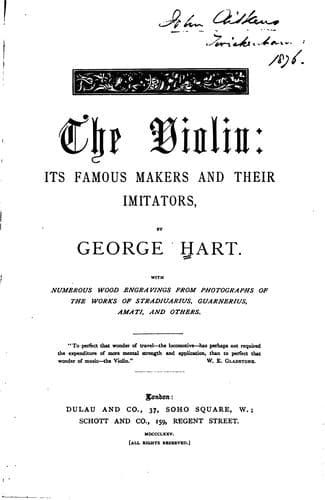
The Violin: Its Famous Makers and Their ImitatorsHart, George
History
The Violin: Its Famous Makers and Their Imitators
Hart, George
Violin -- History; Violin makers -- Biography
Andrea Guarneri for some years worked upon the model of his master,
though he afterwards changed the character of the sound-hole.[9] At
the same time the form of the instrument became flatter, and the
scroll showed signs of originality. The varnish is much varied, but is
generally of a light orange colour of beautiful hue; it sometimes has
considerable body, but when so, lacks the transparency of
light-coloured varnishes. The Violoncellos are of two sizes. The wood
in the Violoncellos is often very plain, but possesses singular
tone-producing qualities. The Violins of this maker are among his
finest efforts; the workmanship is excellent, but has not the fine
finish of Amati.
[Footnote 9: Lancetti, in his MS., mentions 1670 as about the period
of his change of style.]
GUARNERI, Giuseppe Giovan Battista, second son of Andrea, born
November 25, 1666.
Joseph Guarnerius filius Andreae fecit
Cremonae sub titulo S. Teresiae 16--
This maker possessed a greater amount of originality than Andrea. His
earliest works evidence that power of thinking for himself which,
later, led him to construct instruments entirely distinct from those
produced by his father. The outline is particularly striking. The
waist of the instrument is narrowed, rapidly widening, however, from
the centre. The result is a curve of much elegance, one of the points
which Giuseppe Guarneri del Gesu appears to have admired, as he
adopted and perfected it. It is here, more particularly, that a
resemblance between this maker and his famous kinsman is to be traced.
There are also other features which will furnish matter for comment in
their proper place. To return to the form given to the instruments of
Guarneri, the son of Andrea: the sound-hole has a singular combination
of the Amati and the Guarneri in its conception. We have here a
reappearance of the pointed form which originated with the grand old
Brescian master, Gasparo da Salo, and which was left by him to be
revived and perfected by his followers. Andrea's son, in adopting this
long-neglected form, showed much judgment. It must be admitted that he
improved upon it, and left his cousin an easy task in completing and
perfecting it.
The method of this maker with regard to the setting of the sound-holes
in his instruments is peculiar. In his plan they are set in a lower
position than is customary. Carlo Bergonzi followed him in this
particular, and also in placing the hole a trifle nearer the edge of
the instrument than is seen in most instruments. How interesting is it
to observe the salient points wherein each maker seems to have adopted
some isolated feature from a predecessor!
The varnish is of the richest description, and in some instances has
been so plentifully used as to cause it to clot in some places;
nevertheless, its rare qualities are never deadened.
Public-domain text, read in full here on John Shaqi.
Reviews
Reviews
No reviews yet
Be the first to share your thoughts on this work.
Elsewhere in the archive
Join the Discussion
Join the discussion
Sign in to leave a comment or review.
Sign InorCreate an account