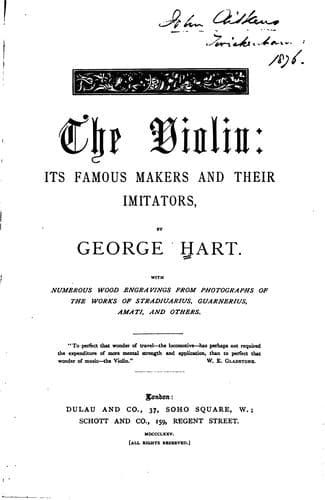
The Violin: Its Famous Makers and Their ImitatorsHart, George
History
The Violin: Its Famous Makers and Their Imitators
Hart, George
Violin -- History; Violin makers -- Biography
The effect of this beautiful coruscation upon the backs of Violins is
obtained by cutting the wood upon the cross, or, as the French term
it, _sur maille_. It is seen, though rarely, on backs divided, when
the wood is particularly handsome in curl. The varnish on such
instruments is of a rich golden hue, highly transparent; it is lightly
laid on. The size of these works varies; they are sometimes a trifle
smaller than the other specimens of Guarneri. In the last epoch we
find Violins of an altogether bolder conception, dating from about
1740 and a little later. They are massively constructed, and have in
them material of the finest acoustic properties. The sound-hole loses
the pointed form so much associated with Guarneri: the purfling is
embedded, the edges heavy, the corners somewhat grotesque, the scroll
has a mixture of vigour, comicality, and majesty, which may force a
smile and then a frown from the connoisseur. The comparison may seem a
little forced, but the head of a thoroughbred English mastiff, if
carved, might give some idea of the appearance sought to be described.
Mr. Reade says of these instruments with much truth, "Such is the
force of genius, that I believe in our secret hearts we love these
impudent Fiddles best, they are so full of _chic_." Among the Violins
of this period may be mentioned Paganini's, and M. Alard's, both rare
specimens. These splendid _chefs-d'oeuvre_ are strangely mixed with
those commonly known as the "_prison Fiddles_"--a sorry title. The
name arose from the story current in Italy that Guarneri made some
Fiddles whilst undergoing imprisonment, and that the gaoler's daughter
procured him the necessary materials, which were of the coarsest kind.
M. Fetis refers to the story, and mentions that Benedetto Bergonzi,
who died in 1840, used to relate it. Allusion is also made to it by
Vincenzo Lancetti, to whom it was doubtless communicated by Count
Cozio di Salabue. These references lead to the belief that the
tradition has some foundation in fact, though not to the extent that
he ended his days _in durance vile_. Lancetti refers to the offence as
an encounter with some person in which his antagonist lost his
life.[11] A deplorable circumstance of this kind may have occurred
without the accused having been criminally at fault, though he may
have suffered the penalty of being so. His reported love of wine and
pleasure, his idleness and irregularity, in all probability were
statements added by successive narrators of the prison story. A recent
search made by Canon Bazzi in the obituary registers of the cathedral
at Cremona, discovers the fact that one Giacomo Guarneri died in
prison on October 8, 1715. Bearing in mind how frequently we find fact
and fiction jumbled together in historical pursuits, the prison story
in connection with the name of Giuseppe Guarneri may have no other
foundation than a story, long current, that a person named Guarneri
was imprisoned, and wholly regardless of identity.
Public-domain text, read in full here on John Shaqi.
Reviews
Reviews
No reviews yet
Be the first to share your thoughts on this work.
Elsewhere in the archive
Join the Discussion
Join the discussion
Sign in to leave a comment or review.
Sign InorCreate an account