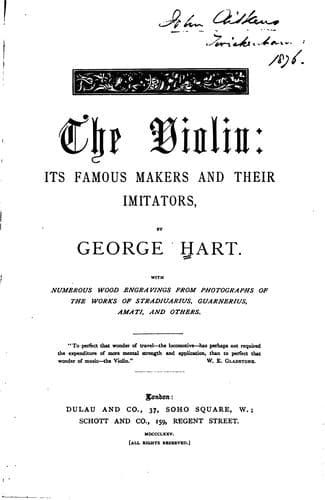
The Violin: Its Famous Makers and Their ImitatorsHart, George
History
The Violin: Its Famous Makers and Their Imitators
Hart, George
Violin -- History; Violin makers -- Biography
In these times, when the love of music is rapidly developing itself
among all classes, the question of supply must attract notice. The
prime question with respect to Violins of the highest character is not
now as to price, but as to the supply of limited and daily decreasing
material; and the doubtful point is, not whether purchasers are to be
found who may not be unwilling to pay the increased cost consequent
upon scarcity, but whether the instruments required will be available
in sufficient numbers to satisfy the demands of those quite prepared
to gratify their wishes for the possession of an instrument of the
first rank. A single glance is sufficient to remind us that the list
of makers of the highest class, and particularly of original artists,
is scanty indeed. There are a few copyists, it is true, notably Lupot
and Panormo, whose instruments must take a considerable position, but
on the whole the demand will far exceed the supply. The difficulty
here noticed is intensified from the fact of the Violin being sought
after as it is, unlike any other musical instrument, for the cabinets
of the collector as well as for actual use--a state of things
perfectly natural when its artistic beauties are considered.
Violinists possibly consider they smart under a sense of wrong at the
hands of collectors who thus indulge their taste; but, on the other
hand, we have reason to be grateful to the lovers of art for having
stayed the hand of Time in demolishing these treasures.
To return to the subject of this present notice: it is evident that
when Montagnana left the workshop of Stradivari, he gave full scope to
his creative powers. He at once began to construct upon principles of
his own, and thus followed the example of his fellow-worker, Carlo
Bergonzi. If comparison be made between the work of Stradivari and
that of Domenico Montagnana, with regard to detail, the two makers
will not be found to have much in common. It is when Montagnana's
instrument is viewed as a whole that the teaching of Stradivari is
evidenced. A similar assertion may, in a lesser degree, be made in the
case of Carlo Bergonzi. To dissect the several points of difference is
a simple matter. If we begin with the outline, that of Montagnana has
not the smoothness and grace of the Stradivarian type; the upper and
lower curves are flattened, while those of the centre are extended.
The sound-hole partakes more of the character of Guarneri; the scroll
is larger, and the turns bolder than in the Stradivari form. These,
then, may be considered to be the chief points wherein, if viewed as
separate items, Montagnana seems to have varied from his master: and
hence we may obtain some idea of the amount of originality belonging
to this maker--an amount, indeed, not inferior to that of any
Cremonese artist that can be cited. The increasing popularity of
Montagnana's instruments is sufficient proof that his design was
fraught with much that is valuable. In departing from the form of
Public-domain text, read in full here on John Shaqi.
Reviews
Reviews
No reviews yet
Be the first to share your thoughts on this work.
Elsewhere in the archive
Join the Discussion
Join the discussion
Sign in to leave a comment or review.
Sign InorCreate an account