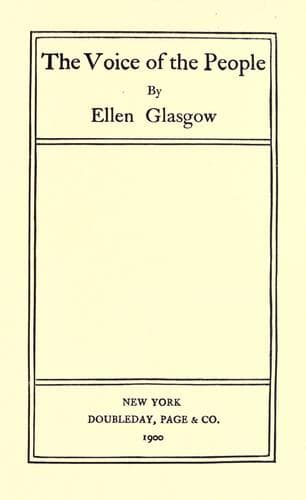
The Voice of the PeopleGlasgow, Ellen Anderson Gholson
General
The Voice of the People
Glasgow, Ellen Anderson Gholson
Virginia -- Social life and customs -- Fiction
"Oh, I am different!" he exclaimed. "A beggar doesn't prove faithless to
a princess--but what do you see in me, after all?"
She laughed. "I see a very moody lover."
They had reached a little deserted spring in the pasture called "Poplar
Spring," after the six great poplars which grew beside it. Eugenia
seated herself on a fallen log beside the tiny stream which trickled
over the smooth, round stones, bearing away, like miniature floats, the
yellow leaves that fell ceaselessly from the huge branches above.
"I don't believe you know how I love you," he said suddenly.
"Tell me," she insatiably demanded.
"If I could tell you I shouldn't love you as I do. There are some things
one can't talk about--but you are life itself--and you are all heaven
and all hell to me."
"I don't want to be hellish," she put in provokingly.
"But you are--when I think you may slip from me, after all."
The yellow leaves fluttered over them--over the fallen log and over the
bright green moss beside the little spring. As Eugenia turned towards
him, a single leaf fell from her hair to the ground.
"Oh! You are thinking of Dudley Webb!" she said, and laughed because
jealousy was her own darling sin.
"Yes, I am thinking--" he began, when she stopped him.
"Well, you needn't. You may just stop at once. I--love--you--Nick--Burr.
Say it after me."
He shook his head. Her hand lay on the log beside him, and his own
closed over it. As it did so, she contrasted its hardened palm with the
smooth surface of Dudley Webb's. The contrast touched her, and, with a
swift, warm gesture, she raised the clasped hands to her cheek.
"I told you once I liked your hand," she said. "Well--I love it."
He turned upon her a hungry glance.
"I would work it to the bone for you," he answered. "But--it is long to
wait."
"Yes, it is long to wait," she repeated, but her tone had not the
heaviness of his. Waiting in its wider sense means little to a
woman--and in a moment she cheerfully returned to a prophetic future.
A few days later Bernard came, and she saw Nicholas less often. Her
affection for her brother, belonging, as it did, to the dominant family
feeling which possessed her soul, was filled with an almost maternal
solicitude. He absorbed her with a spasmodic, half selfish, wholly
insistent appeal. She received his confidences, wrote his letters, and
tied his cravats. Upon his last visit home he had spent the greater
part of his time in Kingsborough; now he rode in seldom, and invariably
returned in a moody and depressed condition.
"You're worth the whole bunch of them," he had said to her of other
girls, "you dear old Eugie."
And she had warmed and laid a faithful hand on his arm. It was
characteristic of her that no call for affection went disregarded--that
the sensitive fibres of her nature quivered beneath any caressing hand.
"Do you really like me best?" she asked.
Public-domain text, read in full here on John Shaqi.
Reviews
Reviews
No reviews yet
Be the first to share your thoughts on this work.
Elsewhere in the archive
Join the Discussion
Join the discussion
Sign in to leave a comment or review.
Sign InorCreate an account