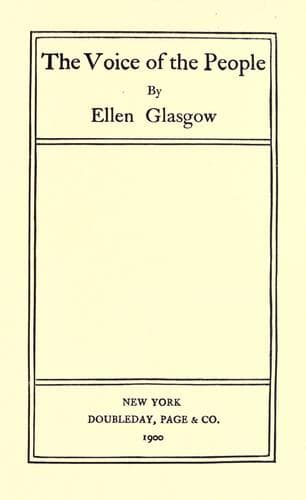
The Voice of the PeopleGlasgow, Ellen Anderson Gholson
General
The Voice of the People
Glasgow, Ellen Anderson Gholson
Virginia -- Social life and customs -- Fiction
The low, irregular landscape was as familiar to him as his own face. He
knew it so well that he could see it with closed eyes--could note each
change of expression where the daylight shifted, could tell where the
thin cornfields ended and the meadows rolled fresh and green, could
smell the stretch of young pines above the smoke of the engine, and
could follow to their ends the rain-washed roads that crawled with
hidden heads into the blue blur of the distance. He knew it all, but he
was not thinking of it now.
He was thinking of the day, fifteen years ago, when he had left
Kingsborough to throw himself and his future into the service of his
State. He had told himself then, fresh from the influence of Jefferson
and the traditions of Kingsborough, that he had but one love
remaining--the love of Virginia. Now, with the bitterer wisdom of
experience, that youthful romance showed half foolish, half pathetic. To
the man of twenty-three it had been at once the inspiration and the
actuality. His personal life had turned to ashes in an hour, and he had
told himself that his public one, at least, should remain vital. He had
pledged himself to success, and it came to him now that the cause had
been won by his single-heartedness--by the absolute oneness of his
desire. There had been a sole divinity before him, and he had not
wandered in the way of strange gods. He had given himself, and after
fifteen years he was gaining his recompense--a recompense for more work
than most men put into a lifetime.
He smiled slightly as he thought of the beginning. In the beginning his
sincerity, had been laughed at, his ardour had met rebuff. He had gone
to Richmond to meet an assembly of statesmen; he had found a body of
well-intentioned, but unprofitable servants. They were men to be led,
this he saw; and as soon as his vision was adjusted he had determined
within himself to become their leader. The day when a legislator meant a
statesman was done with; it meant merely a man like other men, to be
juggled with by shrewder politicians or to be tricked by more dishonest
ones. They plunged into errors, and lived to retrieve them; they walked
blindfold into traps, and with open eyes struggled out again. For he
found them honest and he found them faithful where their lights led
them. He remembered, with a laugh, a New Englander who, after a
fruitless winter spent in scenting the iniquities of the ruling party,
had angrily exclaimed that "if politicians were made up of knaves and
fools, Mason and Dixon's was the geographical line dividing the
species." Nicholas had retorted, "If to be honest means to be a fool, we
are fools!" and the New Englander had chuckled homeward.
Public-domain text, read in full here on John Shaqi.
Reviews
Reviews
No reviews yet
Be the first to share your thoughts on this work.
Elsewhere in the archive
Join the Discussion
Join the discussion
Sign in to leave a comment or review.
Sign InorCreate an account