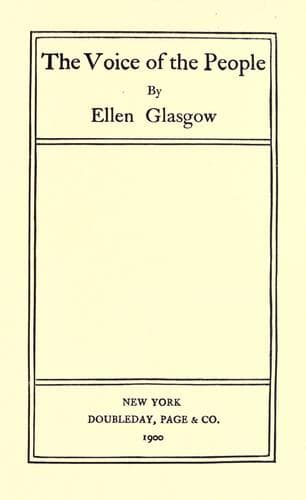
The Voice of the PeopleGlasgow, Ellen Anderson Gholson
General
The Voice of the People
Glasgow, Ellen Anderson Gholson
Virginia -- Social life and customs -- Fiction
Her sensitive mouth drooped. "I never think of your being ugly when I'm
with you," she said. "It's a good, strong kind of ugliness, anyway. I
don't mind it."
He smiled again.
"Looks don't matter, anyway," she went on soothingly. "I'd rather a man
would be clever than handsome;" then she added conscientiously, "only
I'd rather be handsome myself."
He looked at her closely.
"I reckon you will be," he said. "Most women are. It's the clothes, I
suppose."
Eugenia looked down at him for an instant in silence; then she held out
her hands.
"I am going at daybreak," she said. "Will you come down to the road and
tell me good-bye?"
"Why, of course."
"But we must say good-bye now, too. Did we ever shake hands before?"
"No."
"Then, good-bye. I must go."
"Good-bye, dear--darling."
She touched her horse lightly with the willow, but promptly drew rein,
regarding Nicholas with her boyish eyes.
"Do you think it would make it any easier if we kissed?" she asked.
"Geriminy! I should say so!"
He caught her hands; she leaned over and he kissed her lips. She drew
back with the same frank laugh, but a flush burned his face and his
eyes were sparkling.
"More, Genia," he said, but she laughed and let the bridle fall.
"No--no--but it made me feel better. There, good-bye, dear, dear Nick
Burr, good-bye!"
Then she dashed past him, and a whirl of dust filled the solitary air.
He looked after her until she turned her horse into the Old Stage Road,
and the clatter of the hoofs was gone. When the stillness had fallen
again he went slowly on his way.
In the woods the pale bodies of the beeches seemed to melt into the
cloudy atmosphere. There was no wind among the trees, and the pervading
dampness had robbed the yellowed leaves of their silken rustle. They
fluttered softly, hanging limp from the drooping branches as if attached
by invisible threads. As he went on a deep bluish smoke issued from
among some far-off poplars where a farmer was burning brush in a
clearing. The smoke hung low above the undergrowth, assuming eccentric
outlines and varied tones of dusk. Presently the fires glimmered nearer,
and he saw the red tongues of the flames and heard the parched crackling
of consuming leaves. The figures of the workers were limned grotesquely
against the ruddy background with a startling and unreal absence of
detail. They looked like incarnate shadows--stalking between the dim
beeches and the blazing brush heaps. A few drops of rain fell suddenly,
and the fires began slowly to die away. At the foot of the crumbling
"worm" fence, skirting the edges of the wood, deep wind-drifts of
russet leaves stirred mournfully. Later they would be hauled away to
assist in the winter dressing of the fallows; now they beat helplessly
against the retarding rails like a vanquished army of invasion.
Public-domain text, read in full here on John Shaqi.
Reviews
Reviews
No reviews yet
Be the first to share your thoughts on this work.
Elsewhere in the archive
Join the Discussion
Join the discussion
Sign in to leave a comment or review.
Sign InorCreate an account