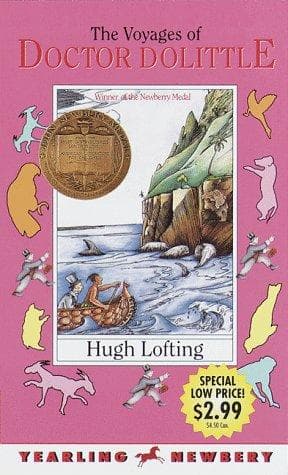
Animals -- Juvenile fiction; Fantasy literature; Human-animal communication -- Juvenile fiction; Voyages and travels -- Juvenile fiction
“Ah!” I said.
“What is it?” asked the Doctor in a hoarse, trembly whisper. “What does
he say?”
“I can’t quite make it out,” I said. “It’s mostly in some strange fish
language—Oh, but wait a minute!—Yes, now I get it—‘No smoking’.... ‘My,
here’s a queer one!’ ‘Popcorn and picture postcards here’.... ‘This
way out’.... ‘Don’t spit’—What funny things to say, Doctor!—Oh, but
wait!—Now he’s whistling the tune.”
“What tune is it?” gasped the Doctor.
“John Peel.”
“Ah hah,” cried the Doctor, “that’s what I made it out to be.” And he
wrote furiously in his note-book.
I went on listening.
“This is most extraordinary,” the Doctor kept muttering to himself
as his pencil went wiggling over the page—“Most extraordinary—but
frightfully thrilling. I wonder where he—”
“Here’s some more,” I cried—“some more English.... ‘_The big tank needs
cleaning_’.... That’s all. Now he’s talking fish-talk again.”
“The big tank!” the Doctor murmured frowning in a puzzled kind of way.
“I wonder where on earth he learned—”
Then he bounded up out of his chair.
“I have it,” he yelled, “this fish has escaped from an aquarium.
Why, of course! Look at the kind of things he has learned: ‘Picture
postcards’—they always sell them in aquariums; ‘Don’t spit’; ‘No
smoking’; ‘This way out’—the things the attendants say. And then, ‘My,
here’s a queer one!’ That’s the kind of thing that people exclaim
when they look into the tanks. It all fits. There’s no doubt about
it, Stubbins: we have here a fish who has escaped from captivity. And
it’s quite possible—not certain, by any means, but quite possible—that
I may now, through him, be able to establish communication with the
shellfish. This is a great piece of luck.”
_THE SECOND CHAPTER_
THE FIDGIT’S STORY
WELL, now that he was started once more upon his old hobby of the
shellfish languages, there was no stopping the Doctor. He worked right
through the night.
A little after midnight I fell asleep in a chair; about two in the
morning Bumpo fell asleep at the wheel; and for five hours the _Curlew_
was allowed to drift where she liked. But still John Dolittle worked
on, trying his hardest to understand the fidgit’s language, struggling
to make the fidgit understand him.
When I woke up it was broad daylight again. The Doctor was still
standing at the listening-tank, looking as tired as an owl and
dreadfully wet. But on his face there was a proud and happy smile.
“Stubbins,” he said as soon as he saw me stir, “I’ve done it. I’ve
got the key to the fidgit’s language. It’s a frightfully difficult
language—quite different from anything I ever heard. The only thing it
reminds me of—slightly—is ancient Hebrew. It isn’t shellfish; but it’s
a big step towards it. Now, the next thing, I want you to take a pencil
and a fresh notebook and write down everything I say. The fidgit has
promised to tell me the story of his life. I will translate it into
English and you put it down in the book. Are you ready?”
Public-domain text, read in full here on John Shaqi.
Reviews
Reviews
No reviews yet
Be the first to share your thoughts on this work.
Elsewhere in the archive
Join the Discussion
Join the discussion
Sign in to leave a comment or review.
Sign InorCreate an account