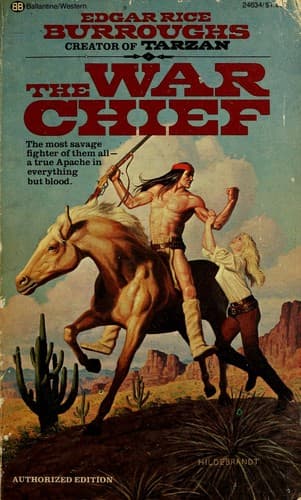
Apache Indians -- Fiction; Historical fiction; Western stories
Nakay-do-klunni scraped it all into his palm, examined it, dropped it
into his own bag, then he closed his eyes and sat in silence, as though
listening. For several minutes he sat thus and Ish-kay-nay was greatly
impressed by this evidence of supernatural power, for was not
Nakay-do-klunni even now in communication with the spirits? When he
opened his eyes and looked at her little Ish-kay-nay came as near
swooning as it is possible to conceive of an Apache. Her lips parted,
panting, she awaited the verdict.
“Shoz-Dijiji not come back,” announced Nakay-do-klunni. He waited
impressively for a moment. “Shoz-Dijiji dead!” He started to give her
the harrowing details, as explained to him by Juh, but the girl had
risen and was walking away. What did Ish-kay-nay care for the details?
It was enough to know that Shoz-Dijiji was dead, that he would not come
back, that she was never to see him again.
Her face betrayed nothing of the terrifying, withering emotion that
scorched her brain. Erect, proud, almost majestic, the little Indian
girl walked out of the camp of the Be-don-ko-he and took her sorrow with
her. Far up into the mountains she took it, to a place that she and
Shoz-Dijiji had known together. Until night she lay there where none
might see her, her supple frame racked by sobs, giving herself wholly to
her grief; nor all during the long night did she move, but lay there in
the awful silence of the mountain, smothering her moans in its rocky
bosom.
When she returned to camp in the morning her eyes were swollen, but dry.
Her father was waiting for her, anxiously, for suicide, though rare, was
not unknown among the Apaches. He told her that upon the second day the
tribe was setting out for the Tonto Basin country; that there was going
to be war and that all the pindah lickoyee would be killed. Everything
would be different then with the Shis-Inday and Juh would be a very
great chief indeed, for all the dead Ned-nis would come back and join
the tribe. He urged upon her the necessity for immediately accepting the
advances of the chief.
Ish-kay-nay was apathetic. She did not care what happened to her now.
Without Shoz-Dijiji there could be no happiness. It might then as well
be Juh as another. It would please her father. Listlessly she gave her
assent. That night the war pony of the chief of the Ned-ni was tethered
before her tepee, and when the tribe broke camp to go to Tonto Basin and
upon the war trail Juh rode off alone with Ish-kay-nay, up into the
hills.
In the foothills near Casas Grandes Shoz-Dijiji lay watching the herd of
the rich Mexican for several days after the troops withdrew, for, being
an Apache, he must reconnoiter carefully, painstakingly, before he
struck. At night he crept down and watched and listened and planned very
close to the corral where the horses were and the house where the
vaqueros slept, until he knew the habits and the customs of the men and
saw that they had not changed since last he had been there.
Public-domain text, read in full here on John Shaqi.
Reviews
Reviews
No reviews yet
Be the first to share your thoughts on this work.
Elsewhere in the archive
Join the Discussion
Join the discussion
Sign in to leave a comment or review.
Sign InorCreate an account