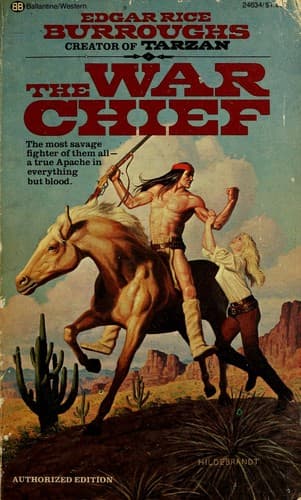
Apache Indians -- Fiction; Historical fiction; Western stories
Up from Fort Thomas rode the first reinforcements for Fort Apache,
spurred on by the rumor that Colonel Carr and his entire command had
been massacred, while from many a hilltop the Ned-ni scouts watched them
and took word to Juh. Gathering their ponies and the stolen herds whose
numbers had greatly augmented their own the Ned-ni set out toward the
southwest to join with Geronimo and the Be-don-ko-he.
Down toward the border, raiding, massacring, fighting off the pursuing
troops, the savage horde moved with a rapidity that is possible only to
Apaches in the uptorn, burning country across which they chose to lead
the suffering troops. Na-chi-ta joined them with his Cho-kon-en, and
there was Mangas and Nanáy and Kut-le and many another famous warrior to
bring terror and destruction to the pindah lickoyee, and with them went
their women, their children and their herds.
Northward, searching for his people, went Shoz-Dijiji, dodging,
doubling, hiding like a beast of prey upon which the hunters are
closing, for in whatever direction he turned he saw soldiers or signs of
soldiers. Never had Shoz-Dijiji seen so many soldiers and they all
seemed to be marching in the same direction, toward Fort Apache. The
young war chief wondered what this movement of troops portended. Had the
reservation Indians arisen, were his people on the warpath, or were the
pindah lickoyee planning a surprise attack in force?
Shoz-Dijiji could not know, he could only guess that something momentous
was afoot, and that where the soldiers of the pindah lickoyee went there
would be Apaches. So he kept to the direction the troops were taking,
longing to meet one of his own kind, watching always for signals.
Patient is the Apache, but the strain of prolonged apprehension was
telling upon the nerves of Shoz-Dijiji. Had it been only a question as
to the whereabouts or the fate of the Apache people Shoz-Dijiji would
have been less seriously affected; but the whereabouts and the fate of
Ish-kay-nay were involved and that was by far a more serious
consideration.
It irked Shoz-Dijiji to think of returning empty-handed. He knew the
raillery to which he would be subjected and which he must accept in
silence. He had failed and so there was nothing to say, for in the
pandect of the Apaches there is no justification for failure. It would
still have been within the range of possibilities to have picked up some
horses were it not for all these soldiers; and so to his other reasons
for hating them there was added this other, the further frustration of
his marriage plan.
Public-domain text, read in full here on John Shaqi.
Reviews
Reviews
No reviews yet
Be the first to share your thoughts on this work.
Elsewhere in the archive
Join the Discussion
Join the discussion
Sign in to leave a comment or review.
Sign InorCreate an account