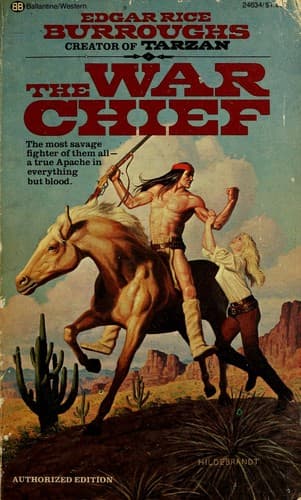
Apache Indians -- Fiction; Historical fiction; Western stories
“I thought that Shoz-Dijiji was dead and I did not care then what
happened to me. It made my father happy.” The effort to speak sent the
blood gushing again from the wound in her breast and Shoz-Dijiji tried
to check the flow, to stay the hand of death. She tried to speak again.
Slowly, haltingly the words came. “Tell Ish-kay-nay—that you—are not
angry, Shoz-Dijiji—that you—still love—Ish-kay-nay.”
“Ish-kay-nay did right,” he said. “Only Juh did wrong. Shoz-Dijiji loves
Ish-kay-nay. Shoz-Dijiji will kill Juh!”
For a long time the girl lay silently in his arms, her breathing so
faint that at times he thought that it had ceased. Terrible was the
anguish of Shoz-Dijiji—silent anguish, all the more terrible because
there was no outward manifestation of it—as he looked down into the
half-closed, dimming eyes of little Ish-kay-nay.
Once she rallied and looked up at him. “My Shoz-Dijiji,” she whispered,
and then: “Hold me close!” There was fear in those three words. Never
before had Shoz-Dijiji heard a note of fear in the voice of Ish-kay-nay.
Very gently the savage warrior pressed the slender body closer. There
was a long sigh and Ish-kay-nay went limp in his embrace.
Shoz-Dijiji, war chief among the Be-don-ko-he, buried his face in the
soft neck and a single, choking sob convulsed his great frame.
CHAPTER XVII
THE TRAIL AND ITS END
DEEP in the mountains in a lone cave Shoz-Dijiji buried Ish-kay-nay,
covered the soft contours of the girlish body with hard, cold rocks,
piled more rocks before the entrance to the cave until it was choked;
buried light and love and happiness in the grave with his sweetheart.
There, beside her grave he spent two days and two nights—days of
mourning, nights of prayer. There he killed the pony he had ridden, that
Ish-kay-nay might find a mount ready to carry her to the spirit world.
This he did, though she was no warrior, nor a great chief, because to
Shoz-Dijiji she was more than either. All the hoddentin he possessed he
had sprinkled upon her before he covered her dear form, and with her he
had buried his most sacred things: his tzi-daltai and his phylactery of
buckskin with its precious contents, even the izze-kloth that
Nan-ta-do-tash had blessed for him.
Upon the third day, alone, on foot, with no medicine to protect him from
evil spirits or from the weapons or machinations of his enemies, he
emerged from the hills, cruel, relentless, stark savage, and turned his
face toward the south upon the trail of Juh. For two days he had been
without food and for one without water, yet he did not suffer. Forgotten
were the sufferings of the flesh in the greater anguish of the soul.
Public-domain text, read in full here on John Shaqi.
Reviews
Reviews
No reviews yet
Be the first to share your thoughts on this work.
Elsewhere in the archive
Join the Discussion
Join the discussion
Sign in to leave a comment or review.
Sign InorCreate an account