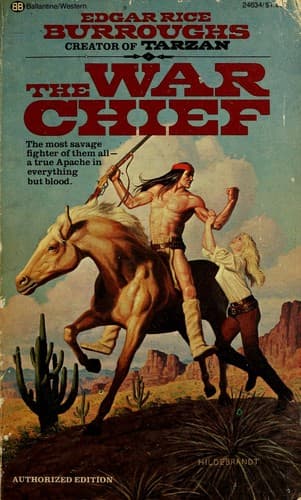
Apache Indians -- Fiction; Historical fiction; Western stories
His vengeance accomplished, Shoz-Dijiji was as a lost soul wandering in
Purgatory, facing a goalless eternity. He ranged northern Sonora, a
solitary figure, grim, terrible. He avoided Indians as sedulously as he
did Mexicans, for the greatest wrong that had ever been done him had
been committed by the hand of an Indian. He felt that all men were his
enemies and that henceforth he must travel alone. He could not know that
the wound, so fresh, so raw, the first hurt that ever had touched his
inmost soul, might be healed by the patient hand of Time; that though
the scar remained the wound would cease to throb.
He lived by the chase, supplemented by an occasional raid when he
required such luxuries as sugar or tobacco, or necessities such as salt,
flour or ammunition. Upon these occasions he walked boldly and in the
broad light of day into isolated ranch house or village store, taking
what he would. Where he met with interference he killed, striking
swiftly, mercilessly, otherwise he ignored the natives. They were as the
dirt beneath his feet, for was he not an Apache, a war chief?
Pride of caste gripped him inflexibly, so that he felt only contempt for
those who were not Apaches. Even though the words of Juh were constantly
in his mind he pretended that they were not. He thought of himself more
jealously than ever as a pure-blooded Apache; the wicked words of Juh
were a lie: “You are white!”
Weeks came and went until they numbered months. “The Apache Devil” was
notorious across Sonora and into Chihuahua. Whole regiments of Mexican
troops were in the field, searching for him; but they never saw him.
Strange tales grew up about him. He possessed the power of invisibility.
He could change himself at will into a coyote, a rattlesnake, a lion.
Every depredation, every murder was attributed to him, until the crimes
upon his soul were legion.
Slowly the wound was healing. He was surprised, almost hurt, to discover
a growing longing for the companionship of his kind. His thoughts, now,
were more and more often filled with pleasant memories of
Sons-ee-ah-ray, memories of Geronimo, of the other Be-don-ko-he who were
his own people. He wondered how they fared. And then one morning he
turned his face northward toward Arizona.
Old Nakay-do-klunni, the trouble maker, was dead; the renegades had
returned to the reservations or been driven in scattered bands across
the boundary into Mexico. The troops were enjoying a well-earned rest.
They were building roads, digging boulders out of parade grounds,
erecting telegraph lines up and down over red-hot mountains and
white-hot plains, until an entire troop would not have rendered out a
teacupful of fat. Always there were detachments scouting, patrolling.
Public-domain text, read in full here on John Shaqi.
Reviews
Reviews
No reviews yet
Be the first to share your thoughts on this work.
Elsewhere in the archive
Join the Discussion
Join the discussion
Sign in to leave a comment or review.
Sign InorCreate an account