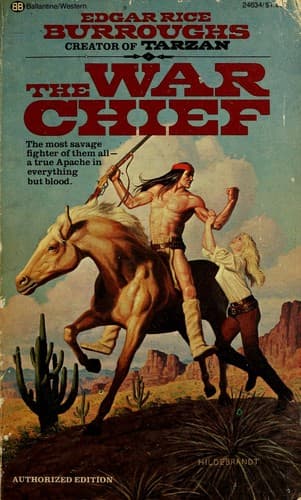
Apache Indians -- Fiction; Historical fiction; Western stories
Then it was that Shoz-Dijiji did something the significance of which
passed above the head of the white girl, something that would have told
her more plainly than words the unique position that she held in the
regard of the red man. There, with a woman present, the Apache warrior
prepared the game, built the fire and cooked the meal. Wichita Billings
took it as a matter of course. Shoz-Dijiji excused it, mentally, upon
the ground that white women were helpless fools, that one of them would
not know how to build a fire without matches and with very little fuel,
how to prepare properly the quail and the rabbit.
It was almost dusk when they had finished their frugal meal. There were
no dishes to wash, but Shoz-Dijiji carefully buried all signs of their
fire and the remnants of their repast. By dark they were moving south
again upon the back of the rested Nejeunee. Down the mountains, out onto
a plain they rode, and by midnight entered another range farther south.
Here Shoz-Dijiji halted again, built a rude shelter for Wichita and told
her to sleep, while he threw himself down upon the ground a few yards
away.
All the following day they rode, through a rough, trailless, mountain
country, the brave finding food where there was none to be seen and
water where the girl would have sworn no water could exist. Wichita was
tired almost to exhaustion, yet the man seemed not to notice that they
had been undergoing any hardships whatsoever. To her he seemed a man of
iron, and almost as silent; and as the hours passed slowly,
monotonously, painfully, there grew within her a sense of trustfulness,
of security that she could imagine harboring for no other man she had
ever known. He seemed a very well of resourcefulness; a sanctuary as
granitic, as eternal as the everlasting bed rock they sometimes
crossed—a demi-god moving surely through a world of his own creation
where there were no secrets that might be hid from his omniscience.
And thus at last they came to the camp of the Be-don-ko-he, but Wichita
Billings was no longer afraid; where Shoz-Dijiji was, there was safety.
As they rode into the camp, there was a tendency to crowd about them and
there were looks in the eyes of some of the squaws that would have
filled her with apprehension had not the great shoulders of Shoz-Dijiji
loomed so reassuringly close; but after he had spoken to them, in words
she could not understand, their attitude changed. Scowling squaws smiled
up at her and one or two stroked her skirt in a friendly way, for
Shoz-Dijiji had told them that she was his friend—a friend of all the
Be-don-ko-he.
They dismounted before a rude tepee where squatted a wrinkled man and
two women. “This is Geronimo, my father,” said Shoz-Dijiji.
Public-domain text, read in full here on John Shaqi.
Reviews
Reviews
No reviews yet
Be the first to share your thoughts on this work.
Elsewhere in the archive
Join the Discussion
Join the discussion
Sign in to leave a comment or review.
Sign InorCreate an account