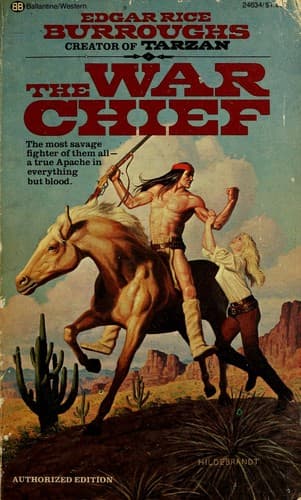
Apache Indians -- Fiction; Historical fiction; Western stories
For some time they sat in silence, the Apache watching the girl’s face,
his own expressionless. What was passing behind that granitic mask? Once
he extended a hand toward her as though to touch her, then he drew it
back quickly and sprang to his feet.
“Come!” he said, almost roughly. “We go back to camp.”
Two days later Geronimo and Shoz-Dijiji thought that it would be safe to
return Wichita to her home, and the young war chief and the girl set out
upon the long journey, which was but a repetition of that which had
ended at the camp of the Be-don-ko-he.
During the journey Wichita could not but notice that the brave scarcely
let his eyes leave her face, a thing of which she had had a growing
consciousness for at least two days before they left the camp. Had she
not come to trust him so implicitly she would have found it difficult
not to have acknowledged something of nervous apprehension as she felt
his gaze constantly upon her; but he took no other liberties with
her—just looked at her through those steady, inscrutable eyes.
Every journey must have an end and at last the two stood upon the very
hill above her father’s ranch where they had stood upon another
occasion. Shoz-Dijiji drew rein and dismounted. “I will wait here until
you are safe in the house of your father,” he said.
“You are not coming down with me?” she exclaimed, surprised.
“No.”
“I want you to, Shoz-Dijiji. I want my father to know you, and thank you
for what you have done for me,” she insisted.
“Me no go,” he replied.
The girl became suddenly conscious of a feeling almost of panic. Was she
never to see Shoz-Dijiji again, this good friend, this best of friends?
She realized, and the realization came as a distinct shock, that this
man of another race had suddenly filled a great emptiness in her
life—an emptiness the existence of which she had never before
realized—and that life was going to be very different without him.
Already she felt a great loneliness creeping over her.
She was standing beside him and now she turned and came close, putting
her two palms upon his breast. “Please, Shoz-Dijiji,” she begged.
“Please come down—I do not want you to go away.”
The contact of her hands upon him broke the iron will of the Apache. The
habitual mask behind which he hid his emotions dropped away—it was a
new Shoz-Dijiji into whose face the girl looked. He seized her in his
arms and pressed her close; his lips covering hers.
She struck at his great chest and sought to push him away; she held her
head from him and he saw the horror in her eyes. Then it was that he
released her.
“Shoz-Dijiji sorry,” he said. “For days he fight the great fire burning
in his brain, burning up his heart, Shoz-Dijiji thought he was strong;
he did not know how much stronger is love—until you touched him. But
you are right. You are white—Shoz-Dijiji is Apache. White girl could
not love Apache. That is right.” He vaulted to the back of Nejeunee.
“Shoz-Dijiji sorry. Good-bye!”
Public-domain text, read in full here on John Shaqi.
Reviews
Reviews
No reviews yet
Be the first to share your thoughts on this work.
Elsewhere in the archive
Join the Discussion
Join the discussion
Sign in to leave a comment or review.
Sign InorCreate an account