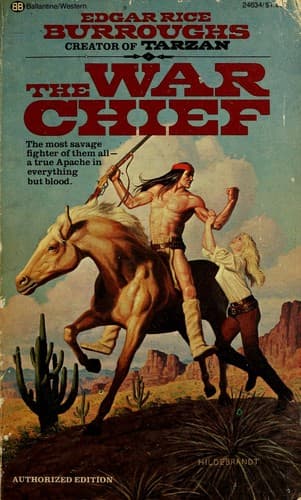
Apache Indians -- Fiction; Historical fiction; Western stories
“Sons-ee-ah-ray,” he said, “I, Shoz-Dijiji, go to be near my father,
Geronimo. The hearts of the pindah lickoyee are bad. Perhaps they have
taken him away to kill him.”
“Go!” said Morning Star. “If the pindah lickoyee harm Geronimo return
quickly and bring the word. Then, if the hearts of the Apache braves
have not turned to water, they will go upon the war trail and drive the
white-eyed men from the land of the Shis-Inday forever. If they do not,
then the squaws will spit upon them and take their weapons from them and
go upon the war trail in their places.”
So Shoz-Dijiji set out alone and afoot for the fort at San Carlos. Deep
in his heart was a purpose that he had not confided to Morning Star or
to any other, not even to Ish-kay-nay when he had bid her farewell. In
the high places Shoz-Dijiji had had much opportunity for thought and for
reflection, and more and more during those solitary hours among the
silent rocks and the murmuring pines there had been borne into his
consciousness a realization of the fact that he had first vaguely
comprehended at the trial of Geronimo at Hot Springs, that his people
were handicapped in their struggle against the white-eyed oppressor by
their inability to understand his language.
Shoz-Dijiji had recalled the night that he had lain close beside the
parked wagon train of the Mexican freighters and overheard their plans
for the ensuing days, and because he knew their language it had been
possible for his people to profit by what he heard. How great might be
his advantage upon similar occasions in the conflict with the whites, if
he understood their tongue, he thoroughly realized. Imbued with this
thought as well as a desire to be near his father and learn more of what
the whites intended for Geronimo, the youth made his lonely way toward
San Carlos.
With a handful of parched corn, a few strips of jerked venison and a
primitive water bottle of horse gut, he trotted silently along his
untracked way. Always alert for signs of the enemy, no sound escaped his
trained ears; no broken twig, no down-pressed bunch of grass, no turned
stone escaped his watchful eyes; and all that he saw he read as quickly
and as accurately as we read the printed page; but with this difference,
possibly—Shoz-Dijiji understood what he read.
Here he saw where klij-litzogue, the yellow snake, had passed through
the dust of the way an hour before; there was the spoor of
shoz-lickoyee; and in the bottom of a parched canyon he saw signs of the
pindah lickoyee. Two days before a white man had ridden down this canyon
toward the plain upon the back of a mare with a white right hind foot
and a black tail. All this Shoz-Dijiji read quickly from a spoor so
faint that you or I would not have noticed it at all. But then, it was
Shoz-Dijiji’s business to know, as it is our business to know that if we
ignore certain traffic signals at a crowded corner we may land in the
receiving hospital.
Public-domain text, read in full here on John Shaqi.
Reviews
Reviews
No reviews yet
Be the first to share your thoughts on this work.
Join the Discussion
Join the discussion
Sign in to leave a comment or review.
Sign InorCreate an account