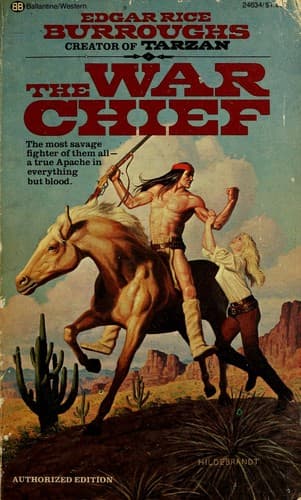
Apache Indians -- Fiction; Historical fiction; Western stories
On the second day Shoz-Dijiji crept to the summit of a low divide and
looked down upon the frontier post of San Carlos, upon the
straw-thatched buildings of adobe brick, upon the winding Gila and upon
the straggling villages of the reservation Indians, and that night he
slipped silently down among the shadows and merged with his people.
There were many tribes there, but among them were Apaches whom
Shoz-Dijiji knew, and these he sought, seeking word of Geronimo first.
They told him that the chief was still chained in a guardhouse, but that
he was well. What the white-eyes intended doing with him they did not
know.
Shoz-Dijiji asked many questions and learned many things that night.
With the braves he laughed at the white fools who fed the Apaches
between raids while the blood of other white men was scarce dry upon
them, and, who, while feeding them, sought to cheat them out of the bulk
of the rations the Great White Chief had sent them; thus increasing
their contempt for the whites, arousing their anger against them, and
spurring them on to further outbreaks.
“Our women and our children are hungry,” complained an old warrior, “and
yet they will neither give us passes to go out on the hunting trail or
issue us sufficient rations to sustain us. We see the agent growing rich
and fat upon the money that should buy us beef. We see our war chief and
our friends chained in prison. To make us content they wish to give us
shovels and hoes and make us do the work of squaws. They wish us to go
to school and learn the strange language of the white-eyes.
“We are men, we are warriors; it is not fit that men and warriors should
do these things. It is our land, not theirs. Usen gave it to us and he
gave the white-eyes other lands. Why do they not stay in the land that
Usen gave them, as we have? We do not want them here.”
Shoz-Dijiji heard a great deal of such talk, for the Indians,
discontented, aired their grievances freely among themselves. They
talked of little else, and the young bucks spoke continually of war.
These matters did not, however, greatly excite Shoz-Dijiji. He knew that
when the time came there would be war. There always was. What interested
him more was the statement of the old warrior that the white-eyed men
wished his people to learn their language. He spoke often upon this
subject, asking many questions.
“You wish to learn the language of the pindah lickoyee?” demanded a
scarred warrior who talked the loudest and the longest about war.
“Yes,” admitted Shoz-Dijiji.
“That is labor,” sneered the warrior. “The men of the Apaches do not
labor. You should have been a squaw.”
“The men of the Apaches make their own weapons wherewith to fight the
enemies of their people, do they not?” inquired Shoz-Dijiji.
“That is the work of men, of warriors,” exclaimed the other.
Public-domain text, read in full here on John Shaqi.
Reviews
Reviews
No reviews yet
Be the first to share your thoughts on this work.
Join the Discussion
Join the discussion
Sign in to leave a comment or review.
Sign InorCreate an account