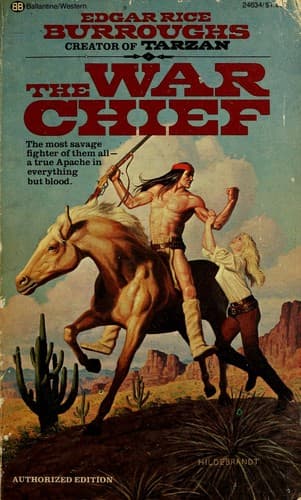
Apache Indians -- Fiction; Historical fiction; Western stories
As Shoz-Dijiji watched through the guardhouse window, his whole being
was so occupied by the numbing terror of what he saw within that he did
not hear the approach of a white soldier from his rear, nor was he
conscious of any other presence about him until a heavy hand was laid
upon his shoulder and he was wheeled roughly about.
“What the hell are you doing here, you dirty Siwash?” demanded the
trooper, and at the same time he gave Shoz-Dijiji a shove that sent him
sprawling in the dust.
Shoz-Dijiji did not understand the white man’s words. He did not
understand why he had been attacked. All he knew was that, his heart
filled with sorrow, he had been watching the humiliation of his father;
but as he arose slowly from the dust he became conscious of a new force
within him that crowded sorrow into the background—a deep, implacable
hatred of the pindah lickoyee. Through level eyes, his face an
imperturbable mask, he looked at the white soldier and saw that he was
heavily armed. About the guardhouse were other armed soldiers.
Shoz-Dijiji turned and walked away. Apachelike he bided his time.
In the camp of his people Shoz-Dijiji took up again his accustomed life,
but he was not the same. The last vestige of youth had fallen from him.
Quiet, serious, even morose he was, and more and more often did he spend
nights and days upon end in the high places, praying and making big
medicine, that he might be strong against the enemies of his people.
He talked with Gian-nah-tah about the wrongs that the pindah lickoyee
would inflict upon the Shis-Inday. He visited Victorio and talked much
with that savage, terrible old warrior, for Shoz-Dijiji wanted to know
“why.” No one seemed to be able to enlighten him. Usen had made this
country for the Apaches, of that they were all quite sure; but why Usen
had sent the white-eyes, no one could tell him. Victorio thought that
Usen had nothing to do with it; but that some bad spirits who hated Usen
were really responsible.
“The bad spirits have sent the white-eyed men to kill the Apaches,” he
explained, “so that Usen will have no one to guard him. Then they will
be able to kill Usen.”
“Then we should kill the enemies of Usen,” said Shoz-Dijiji.
“It is right to kill them,” said Victorio. “Do they not kill us?”
Shoz-Dijiji knew that they did. He knew that when he was hunting, deep
in his own country, he had ever to keep an alert eye open for wandering
white men—hunters, prospectors, cowboys, soldiers—scarce one of whom
but would shoot him first and inquire into his friendliness afterward,
if at all.
In primitive places news travels with a celerity little short of
miraculous. Thus it was that the day that Geronimo was transferred to
the guardhouse at San Carlos the fact was known to the Be-don-ko-he in
their hidden camp, deep in inaccessible mountains. Shoz-Dijiji spoke to
Morning Star, wife of Geronimo, the only mother he had ever known.
Public-domain text, read in full here on John Shaqi.
Reviews
Reviews
No reviews yet
Be the first to share your thoughts on this work.
Join the Discussion
Join the discussion
Sign in to leave a comment or review.
Sign InorCreate an account