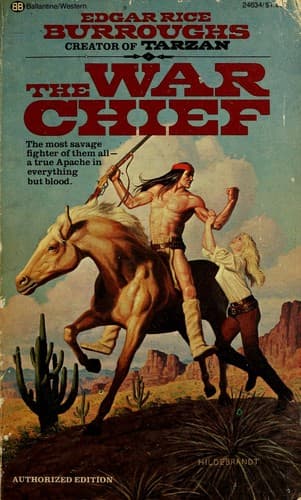
Apache Indians -- Fiction; Historical fiction; Western stories
She pointed a finger at her own breast. “Me, Wichita Billings,” she
announced, and then she pointed the finger at him, questioningly.
“Huh!” exclaimed the Apache. “Shoz-Dijiji,” and he pointed at his own
deep chest.
Without a word he turned and left her, walking south toward the end of
the canyon. The girl followed because in that direction lay the ranch of
her father. When she came in sight of the Apache again he had already
caught her horse and was leading it toward her. He handed her the bridle
rein, pointed toward the ranch and started at a swinging trot up the
side of the canyon. Being a wise girl and having lived in Indian country
since she was born, Wichita Billings put spurs to her horse and
disappeared around a bend in the canyon toward the squat, fortified
ranch house that was her home.
Why the Apache had befriended her she could not guess; but for that
matter Shoz-Dijiji could not guess either why he had acted as he had. He
knew what Geronimo or Juh would have done. He wondered why he had not
done likewise.
Halfway between the ranch and the canyon Wichita Billings met her father
and two of his ranch hands. Faintly they had heard the shots from the
direction of the canyon and knowing that the girl had ridden in that
direction they had started out to investigate. Briefly she told them
what had transpired and Billings was frankly puzzled.
“Must have been a reservation Indian on pass,” he decided. “Maybe some
buck we give grub to some time.”
Wichita shook her head. “I never seen him before,” she said, “and, Dad,
that siwash wasn’t on no pass, he was on the warpath—paint, fixin’s an’
all. He didn’t have nothin’ on but a G-string an’ moccasins, an’ he was
totin’ a young arsenal.”
“Ol’ Geronimo’s been out quite some time,” said one of the hands; “most
likely it was one of his Cheeracows. Wisht I’d a-been there.”
“What would _you_ a-done?” inquired the girl, contemptuously.
“They’d a-been one more good Injun,” boasted the man.
“Say, if you’d been there they couldn’t no one of seen your coat-tails
for the dust, Hank,” laughed the girl as she gathered her horse and
reined toward the ranch again. “Besides I think that buck was one pretty
good Indian, alive; the way he took my part against Cheetim.”
“They ain’t only one kind of a good Injun,” grumbled Hank, “an’ that’s a
dead one.”
From behind a distant boulder Shoz-Dijiji and Gian-nah-tah watched the
four as they rode toward the ranch. “Why did you let the woman go?”
asked Gian-nah-tah.
“Gian-nah-tah,” said Shoz-Dijiji, “this I may say to you because we are
for a long time friends and because Gian-nah-tah knows that the heart of
Shoz-Dijiji is brave: Shoz-Dijiji will never take the war trail against
women and children. That is for weaklings and women—not for a great
warrior.”
Public-domain text, read in full here on John Shaqi.
Reviews
Reviews
No reviews yet
Be the first to share your thoughts on this work.
Elsewhere in the archive
Join the Discussion
Join the discussion
Sign in to leave a comment or review.
Sign InorCreate an account