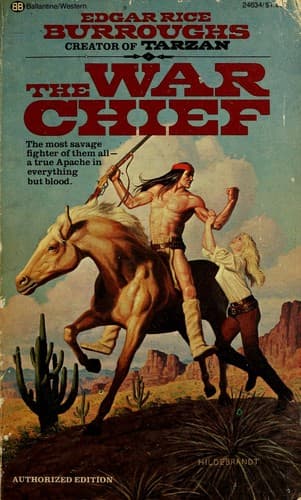
Apache Indians -- Fiction; Historical fiction; Western stories
Little fires crackled merrily, dancing red and orange, shooting sudden
tongues of blue, gold-tipped, lighting copper faces old and wrinkled,
young and smooth, faces stern and terrible, faces light and laughing;
glinting from proud eyes, haughty eyes, cruel eyes, cunning eyes,
laughing eyes, beautiful eyes, the eyes of all Apachedom, the eyes of
all the world. Laughter, gossip mingled with the crackling of the
flames. Little children played pranks upon one another, upon the dogs,
upon their elders, unrebuked, and the full moon mounted the clear Apache
sky to gaze down, content, upon this living poem of peace and love.
Rising gradually above the confused murmur of the camp the measured
voice of the es-a-da-ded arose, insistent. A young brave, gay in the
panoply of war, stepped into the firelight dancing to the music of the
drum. Naked he was, but for a G-string and moccasins, his godlike body
green with copper ore, his face banded with yellow ocher, vermilion,
blue; upon his head a war bonnet of eagle feathers; in his hand he bore
a lance, a quartz-tipped lance to the point of which was tied something
that fluttered as the tip moved—human hair. Shoz-Dijiji bore aloft a
trophy in the scalp dance of his people.
Behind him came other braves, painted braves; singing, yelling braves,
shouting the savage war whoop that has carried terror down the ages, out
of the north, across a world. Grisly tassels waved from many a point.
Rifles cracked. Admiring squaws looked on. Ish-kay-nay was among them,
her great, dark eyes clinging ever to the mighty figure of her lover.
Weaving in and out among the fires the warriors danced, yelling, until
they were upon the verge of exhaustion; but at last it was over—the
last scalp had been discarded, a vile thing that no Apache would retain.
The camp slept. In far places the scouts watched, guarding against
attack. Shoz-Dijiji came among the banked fires, leading Nejeunee. To
the tepee of Ish-kay-nay he led him and there he tied him and went away.
In the morning, when Ish-kay-nay arose she looked out and smiled; but
she did not come forth until the camp was stirring and there were many
about to see her. Others looked at the pinto pony tied there before the
tepee, and smiled, too.
At last came Ish-kay-nay, with the carriage of a queen, the step of a
panther. She did not hesitate, but taking the rope that held him she led
Nejeunee, the war pony of Shoz-Dijiji, to water, and then she fed him.
Everyone saw, but there was none that laughed behind his blanket at
Ish-kay-nay, or thought her immodest; for there was but one Ish-kay-nay
and she could do no wrong, she who all her life had done as she pleased,
haughtily indifferent alike to censure or to praise.
Public-domain text, read in full here on John Shaqi.
Reviews
Reviews
No reviews yet
Be the first to share your thoughts on this work.
Elsewhere in the archive
Join the Discussion
Join the discussion
Sign in to leave a comment or review.
Sign InorCreate an account